This is your fault. Well, maybe not yours in particular, but over the years enough people have told me I should write down whatever story I was telling them, I’ve decided to do it. Perhaps I am ill-advised. No matter. Bad advice often leads to interesting stories.
David has helped and encouraged us to tell the stories that should not be forgotten. Some are personal, meant only for family and friends. Others document for all readers and historians the experiences of military service in the words of those who lived them.
It’s been a privilege to participate in the Mighty Pen Project. Being part of David’s class and sharing collegially with other writers has helped me tell the stories I couldn’t tell alone. Together, we have helped each other articulate not only the details of our experiences, but the profound truths inherent in them.
If you would like to read or hear these stories, The Virginia War Memorial provides access in two ways:
The Mighty Pen Project Anthology & Archive which preserves, shares, and honors stories written by military veterans and their supporters. Access this rich collection of creative, deeply expressive, and vital documents of service and history here:
The Mighty Pen Podcast which premiered in January 2024. It is a culmination of ten years of Mighty Pen writing classes and shared veterans’ stories. As part of the tenth anniversary of the MPP, the podcast brings select stories to life with dramatic readings by professional actors. The readings are followed by interviews with the writers themselves. This program shares a vast range of experiences had by veterans and their families during war and peace times, during and after their service. The Mighty Pen Podcast is available on Apple Podcasts, Spotify, and the VWMF YouTube Channel. New episodes will drop every Tuesday throughout 2024 to commemorate the MPP’s anniversary.
This week, my story, Eyesore, read by Caitlin Nolan, can be heard here:
Camp Chesty, on the outskirts of An Numaniyah, occupied a patch of desert the Marines had taken from the Iraqis on 3 April on their way to Baghdad. Part airfield, it hosted the 1st Marine Expeditionary Force headquarters and subordinate units, housed in tents. Each unit had its own space, separated from the others by sand berms pushed up from the desert floor. Our medical unit, known as the “Devil Docs” arrived on 8 April and set up next to the Harrier landing zone. Having one of those land in your front yard is a spectacle deserving notice. During the day, we would gawk, fascinated at how such a large plane could stop in mid-air and lower itself to the ground. Nighttime required us to be less impressed and more vigilant, since lights left on in a ward or a barracks tent could misdirect and bring a Harrier down on us.
As the only chaplain for the field hospital, I lived on the far edge of the camp between the mortuary and the helo LZ, so I would know immediately when dead or wounded “guests” arrived. The front ¾ of my tent served as the chapel, with wood Connex boxes for pews and altar. My tent mates and I shared the back quarter, divided from the chapel by poncho liners we’d hung for privacy. One of my tent mates was a podiatrist in her mid-twenties who spent her days debriding or amputating feet. The other was the psych tech assistant to my battle buddy Gary, the psychiatrist.
Bald and goofy, Gary’s irreverent sense of humor eased tension in the camp and kept me from justifiable homicide. I lessened his homesickness by being an eager audience for daily tales of adventure starring his eight children. Since we were responsible for everyone else’s mental and spiritual stability, Gary and I kept each other’s secrets and sanity.
One constant in our camp was sand. It swirled around in sidewinders you could see coming across the desert floor. It coated everyone and everything with powdered silt. It stiffened drying underwear, if there’d been enough water to change skivvies from “dirty dirty” to “dirty clean.” It mixed with smoke from our burn pit where we disposed of body parts, bloody blankets, plastic, and everything else no longer viable. And each night it coated my rations, aptly dubbed “tray rats,” as I carried them from the chow tent to ground seating outside.
The chow tent was conveniently located next to the port-a-potties for easy disposal of filtered grub, no matter from which human opening it spewed. This proved helpful for most of the hospital staff who suffered from gastrointestinal issues. I saw it as proof medical types were clueless about basic hygiene. If you didn’t eat so close to where you shit, you wouldn’t need to shit close to where you eat.
I tried to address the issue with the Executive Officer. “Our toilets are plywood seats over metal drums. The flies that land in those drums are the same flies that land on our food. We need to move the chow tent.”
What I got in response was the usual “Chaplain, we’re trained medical personnel. We know what we’re doing. Please stay in your own lane.”
So, there I sat, on the ground, like I did every evening, trying to find an edible portion of the silt-coated goo on my Chinet plate. Within seconds, a fly landed. I swatted him with my spork. He ignored me.
“I know where you’ve been.” I swished my hand at him. He didn’t move. “You’ve been in the shit. Go.” He didn’t. Hungry, I slipped my Spork underneath the silt and took a bite.
“Talking to flies, now?” Gary asked as he lowered onto the sand. “Wanna tell me about it?”
“This is my fly. Get your own.”
He held out his plate. “Already got one. Um, two.”
“Don’t brag.”
“How’s it going?”
“Okay, so far.”
“That’s a punchline. Here’s the joke. A man jumps off the top of a skyscraper. When he passes the 18th floor, a woman leans out the window and asks, ‘How’s it going?’”
“Dare I ask you the same question?”
“Okay so far… Uh oh.”
“What’s the matter, Gary?”
He pointed behind me. I turned to see a Marine hurrying in our direction.
“Chaplain,” the Marine called as he waved to get my attention. “Chaplain. They need you in triage.”
Translation: we have a dead body. Committed to healing, medical personnel hated to deal with the dead. That was a lane they were happy to leave to me.
“They’re playing my song, Gary. Looks like you and your wee buddies will be dining alone.”
On my way to triage, I tossed my dinner with its complimentary fly into the burn pit.
Corpsmen were already unloading patients when I arrived.
“Ambulance?” I asked the triage coordinator. “Not helo? Traffic accident?”
“Gun range. Nearby. Here comes the first one.” She hurried to direct the corpsmen to place the litter on the left side of the triage tent. Blood permeating through torn uniform left droplets in the sand at my feet as they passed. Gun range? What the hell happened out there?
Five more bleeding Marines arrived on litters. The triage coordinator sent one to the left and four to the right. Selection. I hated this part. Stateside, the patient with the most severe injuries would get the first and best care. Here, if treating them would significantly reduce the care and resources available for other patients, or if the likelihood of survival is too low, they’re set aside and given only comfort care. Me. This could be a long night.
Soon a seventh litter came off the ambulance. It carried a body bag. A leaking body bag.
A corpsman stopped in front of me. “Chaplain, where do you want him?”
I pointed to a spot outside the tent where there would be less foot traffic. The corpsmen headed there, then gently rested the litter on the ground.
“Is there anything else you need from us, Chaplain?”
When I gave them the answer they’d hoped for, they headed back to the ambulance. Mopping blood, in this instance, was the preferable choice.
I knelt next to the bag marked “Human Remains. Content – One Each,” and reached for the zipper.
“Chaplain, we need you,” sounded from inside the triage tent.
I patted the bag. “I’ll be right back. I just have to see about one of your buddies.”
“Over here,” the nurse said. She leaned closer to me. “He’s not going to make it.” I nodded as she walked away to assist the next patient.
In front of me lay a barely conscious Marine in his thirties. I slipped my left hand under his. Still warm. “Can you hear me?” A faint squeeze. “I’m Chaplain Bender.” With my other hand, I reached for his dog tags. “Kevin, I won’t leave you. I see you’re Catholic. How about I offer these words to God on your behalf?” I reached in my cargo pocket and pulled out my Prayers for the Dying cheat sheet. “In the name of the Father, and of the Son and of the Holy Spirit. Hail Mary. Full of grace…” Before the prayer ended, I felt his hand relax. Kevin was gone.
“LT,” I called. “You need… he’s uh…”
The nurse poked one of the docs working on the nearby patient. When he walked over to check Kevin, I went outside to take care of the Marine in the leaking bag. I knelt beside him and slid the zipper down enough to find his dog tag, then rezipped it. Buddhist. That’s a new one. I checked my cheat sheet. Catholic. Protestant. Jewish. Muslim. No Buddhist. I closed my eyes. Now what, God? Now what do I do? I have no idea what to say for a Buddhist. I placed my hand on the bag. “Dear God, this young Marine deserves a proper prayer. Don’t let my ignorance take that from him. O God, may my weak words suffice.” Lost in thought, I sat with him for a few minutes until screams from inside the tent caught my attention. On my way into triage, I told a corpsman our deceased Marine was ready for his trip to the freezer.
Only two Marines remained in the tent. On the right, a corpsman was calmly cutting the uniform off her patient while a nurse readied some equipment. On the left, the medical staff was struggling to hold down their writhing, screeching patient. I took a deep breath to steel myself as I listened to his pain-filled cries. A few minutes later, he let out a loud moan, then slumped back on the litter.
“Chaplain. We need you.” I walked toward the group, now standing in a circle around the litter.
“You’ve done your best to save this Marine. He was just too wounded. How about we take hands and offer a prayer for him, his loved ones, and the good work you’re doing for all our patients?”
With hands clasped or on shoulders, the medical staff bowed their heads. I began the prayer. Then I paused, so others could offer their own heartfelt words. When we finished, everyone returned to their work, which was far from over.
“Get the chaplain. I know she’s here. I want the chaplain.” The voice came from the other side of the tent.
I walked toward the remaining patient. “Hi, I’m Chaplain Bender. You’re looking for me?”
Naked from the waist down, the Marine held a Bible close to his chest. “She’s trying to take away my Bible. Tell her she can’t do that.”
I turned to the nurse. “What’s up with the Bible?” I asked, so the Marine could hear her answer.
“He has shrapnel wounds on his lower body and may have some on his torso. He could bleed out if we don’t find them. We only want him to let us cut off the rest of his uniform so we can check.”
“Gunny, that seems reasonable to me. How about if I hold your Bible in front of you so you can see it while they check for wounds?”
He nodded and handed over the book. The nurse continued to work on his lower half, while the corpsman cut off his Cammie blouse and tee shirt.
“Gunny, what’s your name?”
“Alpha, Alpha, Romeo, Oscar, November…” While he rattled off the NATO phonetic letters of his last name, I struggled to make sense of his first. Finally, I got it.
“Aaron, right? Your name is Aaron?
“That’s what I just told you.”
Once his uniform was off, I returned his Bible.
“Aaron, I’d like to say a prayer for you. What would you like me to pray for?”
In a loud voice he said, “Chaplain, pray this nurse takes that tube out of my dick.”
No sound followed his pronouncement. Across the tent, work on the deceased paused. People stopped mid-stride. The gunny’s nurse stared at me, mouth agape. I leaned toward her so only she could hear. “Yes, I will pray, but there will be no laying on of hands or anointing with oil.”
She giggled and spit. Then she resumed her work. Thank you, gallows humor for the save. Slowly, others went about their way. I prayed for the Gunny, then left the tent.
Outside triage, I took a seat on a Connex box to wait for the sunset. I needed to catch my breath. I should have walked further away, because just after my butt hit the wooden box, a Marine I didn’t recognize headed straight for me.
“Where are my men? I know they came here. Where are they?” he asked. “I wasn’t with them when it happened. I should have been there.”
“Do you mean the men who arrived by ambulance?”
He nodded. In the dimming light, wet streaks betrayed where tears had fallen over the layer of sand coating his face.
“Come sit with me for a minute. Then I’ll take you to admin to get the full report.”
He lowered himself onto the box across from me. “Have you seen them? I know some of them are dead.”
“Are you the supervisor of these Marines?”
“No. We’re all friends. We’ve served together for years. Our wives and kids are friends. I should have been with them, but I stayed back to finish paperwork.”
“Stayed back from where?”
“A range near here. We’d captured some Iraqi RPGs, and the guys wanted to get more familiar with them. They’d been shooting all afternoon when a round cooked off in the chamber…”
“I’m sorry. The ambulance brought seven of them here. We were able to save four.”
“Who’s gone? Who died? Can I see them?”
“How about I take you to admin to get the official word, then I’ll meet you afterwards?”
With no other plan, he agreed to that one. I escorted him to admin and went off to find Gary. On the way, I stopped by the chow tent to grab a bottle of water and a paper cup.
Gary was sitting outside his tent when I arrived. “Dare I ask,” he said as I neared.
“I’m okay so far, but three others have reached their destination. I think the other four will make it. You still have that little electric water heater? I need to make tea.”
“Here, have a cookie while I look. My wife baked it.”
“I know what you’re doing. Standard critical incident check-up. If I can eat after going through a trauma, I’m past the critical stage.” I took a bite. Much better than the fly covered mush.
“And why do you need to make tea? Take a cookie for whoever it is.”
“Thanks. I might bring him by for an overnight eval. Three of his friends just died.”
“I’ll fluff the pillows on the extra cot.”
I stopped by the chapel tent to dig a tea bag out of my personal stash. I plugged the heater into a generator near admin, poured in water from the bottle and waited. When it was hot enough, I poured it over the tea bag. The smell of peaches rose from the cup. I closed my eyes and inhaled. Home.
“Chaplain, I’m finished with admin.”
“Did they give you the information to take back to your unit?”
“I got what I came for, but not what I wanted. I should have been with them.”
“Here you go,” I said, handing over the cup of peach tea and the homemade cookie. “Tell me about your friends.”
We talked for a while. He drank the tea, but I had to remind him twice about the cookie.
“I need to return this,” I said, holding up the water heater. “It belongs to one of our docs. Come, walk with me.”
Gary was still sitting in front of his tent when we arrived. After introductions, which did not include what kind of medicine he practiced, Gary pointed to the empty cot.
“Hey, why don’t you stay here tonight? The road is barely safe in the daylight. I don’t want you to have any more problems tonight. You can hang here with me and my tent mates and we can finish my wife’s cookies.”
Confident the distraught Marine would be safe bunking with a psychiatrist, two psychologists and a few psych techs, I took my leave and headed for the ward to see how the Gunny was doing. I found him with his Bible tucked under his arm.
“How you feeling, Aaron?” I pulled a folding chair next to his cot.
“Not so good, Chaps.”
“How about you rest, and I’ll read you some passages from your Bible?”
He handed it over and closed his eyes.
I began with the 23rd Psalm. “Yea though I walk through the valley of the shadow of death, I will fear no evil.” I moved on to the 91st. “Because he loves me,” says the Lord, “I will rescue him; I will protect him. I will be with him in trouble. With long life I will satisfy him and show him my salvation.” Then the 46th. “God is our refuge and strength, a very present help in trouble.” For almost an hour, I read to him words of promise, hope and salvation.
A corpsman walked up behind me. “Chaps, we have to turn the lights out now. We don’t want to be mistaken for an LZ.”
I nodded and rose to go. Aaron seemed to be sleeping, anyway.
“Don’t leave me,” he whispered.
I lowered myself back into the chair. Since it was now too dark to read, I continued with what I misspent my youth memorizing: Hymns. “When peace, like a river, attendeth my way, when sorrows like sea billows roll; whatever my lot, thou hast taught me to say, it is well, it is well with my soul.” And “Through many dangers, toils and snares, I have already come. Tis grace that brought me safe thus far and grace will lead me home.” I sang until my voice grew hoarse. Before leaving, I reached for Aaron’s hand to pray for him. Clammy. I felt his pulse. Much too fast for someone sleeping. I squeezed his hand, but he didn’t wake up. I switched on my red lens penlight and went in search of a nurse. He returned with me.
“I’m glad you came to get me, Chaps. I think he’s going into shock. I’ll take it from here.”
Duty done, I headed to my tent. Just outside, I paused under the night sky. Then, exhausted, I curled up on top of my dusty sleeping bag to rest.
+ + +
Camp Lejeune, NC
My assistant stuck his head into my office. “Is it okay if I go to lunch? Oh, and Chaps, you got a visitor.”
I grinned. “Have a nice lunch. Tell your wife I said ‘hi,’ and send the visitor in.”
“Roger that, ma’am.”
I stood to greet my guest. He looked familiar. “Have we met before?” I gazed at the last name stitched over the right pocket of his Cammie blouse. Then it clicked. “Alpha Alpha Romeo Oscar November?”
“Yes, that’s right, ma’am. How’d you know my first name?”
“I’m surprised to see you again, Gunny. Have a seat. What’s up?”
“It took me a while to find you, but once I figured out you were at Lejeune, it was easy.”
“Being the only female chaplain helps narrow it down.”
He nodded. “The reason I needed to see you is this: I have no recollection of what happened to me, and the Marines who died, beyond arriving by ambulance. I’m hoping you can help me remember. It’s all so fuzzy in my brain and I really want to know.”
Ouch. Since arriving back at Lejeune months ago, I’d been doing what everyone else had been doing. Stuffing those memories out of sight, and as best I could, out of mind. The last thing I wanted to do was dredge up that shit. But the Gunny had made an effort to find me. And he said he needed to know. So, against my better judgement, I told him. Everything.
I told him about the friend who died quietly and the one who screamed his way out. I told him about the distraught friend who came in search of his buddies, and the one in the body bag. He listened intently. Then he asked about himself, prefacing with a brief description of the surgeries he’d had after he left us.
“Do you really want to know what happened to you in triage?” I asked. “Because it was rather memorable.”
“Then I really want to know.”
I began with the phonetic spelling of his name, the struggle over his Bible and… then recounted the funniest prayer request I ever received.
“Sounds like me.” He grinned.
I mentioned I had spent time with him in the ward, reading from his Bible.
“I’m sorry, Chaps, I don’t remember that at all. But thanks. I’m sure it helped.”
“You were going into shock. I’m not surprised you don’t remember.”
We talked a little more. Then he rose and headed for the door.
“Thanks for talking with me, Chaps, today, and when I was injured. Maybe I’ll see you sometime again.” He walked through the door and into the hallway. A few seconds later, he returned.
“You sang to me, didn’t you?”
“Yes, Gunny, I did.”
“I thought so.” He smiled as he left.
I shuffled the papers on my desk into a neat pile to be worked on after lunch. On my way to the door, I hit the light switch. In the darkness, it all came flooding back. Images. Screams. Odors. Flies. I leaned my forehead against the wall and wept. “God, you know where I’ve been.”
In the next few days, many of us will gather with extended family to celebrate the holidays. For some, this will be a joyous occasion filled with laughter, stories, good food and the chance to relax with people they love.
Others will spend quality time with relatives who insist on indulging in a favorite addiction, sharing polarizing political views, or displaying gross disrespect at high volume. Since choking the living daylights out of these people will likely displease the host who compelled you to attend the annual installment of the family drama, here are some ways to make it from hors d’oeuvres to dessert without police intervention:
All adult relationships are voluntary. No matter how much your family pleads with you to attend the festivities, you can choose to stay away. You can also choose to manage your attendance by reducing the time you are there, staying in a hotel room if it requires an overnight, or taking a walk with a relative whose company you cherish.
You don’t have to attend every argument to which you are invited. When someone tries to goad you by expressing opinions with which you disagree, you don’t have to respond. Walk away, change the subject, have a bathroom emergency, or simply say, “I’m not going to talk about that today.”
Watch out for HATS. That applies to both you and your relatives. HATS, an acronym for Hungry, Angry, Tired or Sick, describes the times when it is not a good idea to engage in any important communication. When you are “HATS,” you should not talk about your in-laws with your spouse, discuss work challenges with your supervisor, negotiate with roommates about chores, or try to register your vehicle. You should definitely not show up that way to holiday gatherings with extended family. If HATS is an issue for an otherwise pleasant family member, bring them a plate of food, an aspirin or suggest a nap. That might be all they need.
The shortest distance between despair and hope is often a good night’s sleep. To follow on the HATS issue, make sure you are well rested before you attend.
To forgive is to set a prisoner free, only to realize you were the prisoner. This doesn’t mean you must condone or minimize bad behavior. It also doesn’t mean you must reestablish a relationship with the person who hurt you. To forgive is to release yourself, not the perpetrator, from the harm done to you. Forgiveness may also be described as “giving up all hope of a better past.” That might sound silly—who hopes for a better past? But how often do we recount the same old hurts, as if one day the ending will somehow come out better? To forgive is to let that story go, and allow new stories to blossom in its place.
If you are grieving and someone says something like “God needed another angel,” or “She’s in a better place,” or “God never gives you more than you can handle,” here is the translation: “I’m clueless and uncomfortable about what to say, but I care and I’m sorry.”
Hurt people, hurt people. If you think back on your last few family gatherings and realize you were the one who created the tension, this might be the year to be a no show. It’s better to miss an event than to make everyone else wish you had. Then spend the time before the next gathering taking care of yourself. Go to therapy or rehab. Apologize. Learn to let others have an opinion you don’t feel the need to refute. Take meds if necessary. You don’t get extra points in life by toughing it out and making yourself and everyone around you miserable. You deserve a better life and so does your family.
This year, may you not only survive the family gathering, may you seek and find the hidden joys in the midst of it.
A friend sent me a cartoon that, as she intended, gave me a good laugh. It was a drawing of a woman standing behind a table with the contents of her purse strewn across its surface. She had a look of panic on her face and a cell phone stuck between her shoulder and ear. “I have to hang up. I’ve misplaced my phone. I can’t find it anywhere!”
Of course, I laughed. I’ve had lots of experience with this problem. Where are my sunglasses? (top of my head) Where is the house key? (doorknob) Where is my ID? (Check the other pocket)
While it’s frustrating to search for an object that should be close at hand and often still is, it can be distressing when what we’ve lost sight of is an intangible. Hope, for instance, or God’s love. The peace that passes all understanding or God’s call on our life. Self-worth, grace or God’s providence. Faith.
One night, it happened to me. I woke from a sound sleep. Something had touched off a chattering of worries inside my head and soon I was in a panic.
What if this or that happened? What would I do? How would I get by? The questions swirled and danced and escalated my brain into a tizzy. The tossing and turning woke my husband.
“What’s the matter this time?” he asked.
“I dunno. I was just worrying.”
“Are the Four Horsemen of the Apocalypse in the driveway yet?”
I sat up and peered out the window into the darkness.
“Nope.”
“Then go back to sleep. God has your back.”
I knew that. In fact, I rely on it. But for a moment it had slipped out of my vision, like the gloves I went searching for the other day and couldn’t find until I looked down at my hands. I had been wearing them all along.
“…when I awake, I am still with you.” Psalm 139:18
My grandmother lived two doors away when I was seven. I loved to visit and did so often. One afternoon, on her way to town, my mother pulled up in front of Nana’s mailbox. “Get in,” she shouted.
I walked to the passenger side of the car. “Wait, I forgot something.” I ran back to the stoop. My retrieval only delayed us a few seconds. Then I got in the car and we took off toward town.
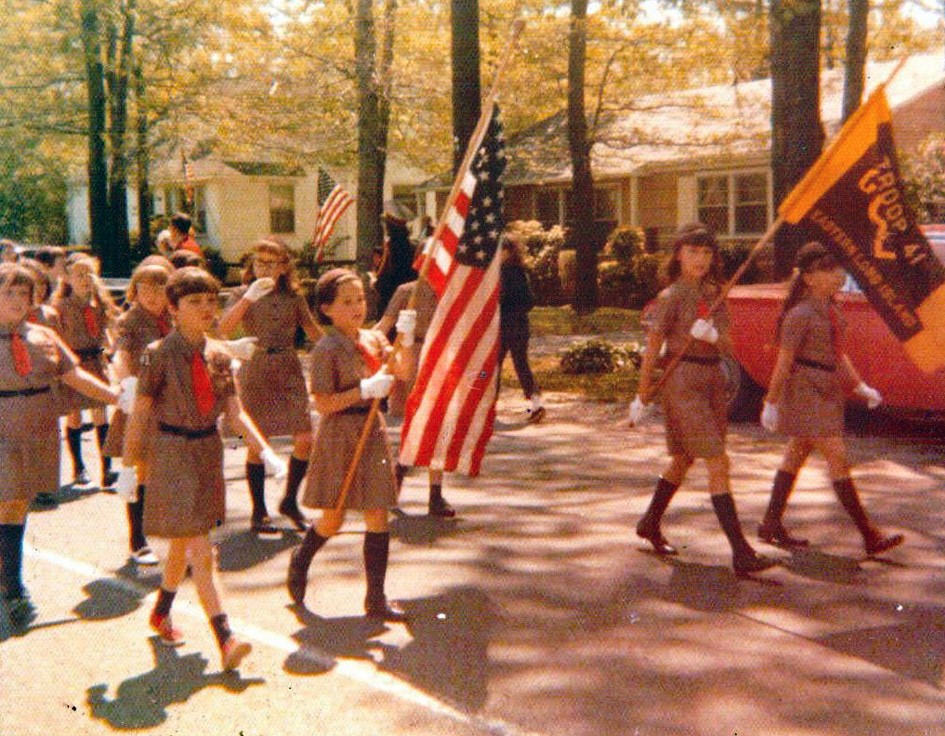
My mother was not happy with me. Why couldn’t I have been ready when she wanted to go? Why did I have to go back and get… whatever it was I’d left on the stoop? I always made her late, she said. My mother was in full tirade when we reached Five Corners. We turned left on Hawkins Avenue, then a few blocks later took Ronkonkoma Avenue when it branched off to the right. In the triangular-shaped piece of land created where the road forked was a small Veteran’s Park. My Brownie troop laid a wreath there every Memorial Day. I smiled, remembering how much I enjoyed being part of that ceremony with all those people in uniform who took care of us.
When we reached the intersection with Portion Road, we stopped for the traffic light. Ours was the second car in line. Impatient to get wherever we were going, my mother complained. “It’s your fault. If only you had been ready on time.”
When the light changed, the car ahead of us proceeded into the intersection. A vehicle running through the red light impacted it on the driver’s side, crushing the woman at the wheel.
Years later, I attended a Yankee game in New York City during Fleet Week. A woman walked up to me and pointed to the name tag on my summer white uniform.
“Are you from the ship made with the steel from the twin towers?” she asked.
“Yes, I’m the chaplain.”
Her eyes filled with tears as she took off the copper memorial bracelet she’d been wearing. She placed it on my wrist. “Please wear this when the ship is commissioned. It would mean a lot to me to know he is on that ship.”
I asked her about the person whose name was engraved in the metal. “My partner,” she said. “An EMT. We were working together at the towers on 9/11. I went to the right, and he went to the left as the building collapsed. I never saw him again.”
The question is begged by the reality. How is the future determined? Is it by the fickle finger of fate? The playing out of a divine scenario or the laws of physics? Is it by an object left on the stoop, a few seconds of time, or the decision to turn one way and not the other? And how is our path directed? By the laying of a wreath, a difficult mother, a commitment to serve, or the need to ask these questions and seek an answer? How does it all come together? So many questions; not enough answers.
In the Valley of Elah, two armies faced one another: the army of the Philistines, and the army of the living God. From among the Philistines, a booming voice raised a challenge: “Choose a man for yourselves and let him come down to me.” When the Israelites saw Goliath, the source of that challenge, they were overcome with fear. Before them stood a man of formidable size and power clad in armor made to protect him from all harm – a conventional warrior on steroids.
When young David appeared at the line of battle, he asked a strategic question his tactically focused brothers had yet to discern. Other than being large and loud, “who is this uncircumcised Philistine that he should defy the armies of the living God?”
“Let no one’s heart fail because of him; your servant will go and fight with this Philistine,” David proclaimed. And despite protests from the king on down, that’s what he did. Abandoning the burdensome armor and conventional weaponry of his day, David faced off against Goliath with the tools with which he was most adept: a slingshot and a bag containing 5 smooth stones–four more than he needed. But he wasn’t armed with just a shepherd’s weapon. David faced his opponent with something his adversary was lacking, and his brother’s army had forgotten—the knowledge that the battle belongs to the Lord. And with faith in the living God, David fought and prevailed.
Years ago, I had the honor of meeting some of the fiercest fighters of the Marine Corps. Men who had faced off against a brutal enemy – not in the Valley of Elah, but in places with names like Tulagi, Tasimboko, Guadalcanal, New Georgia and bloody Edson’s Ridge. An elite force trained to close with and destroy the enemy, Edson’s Raiders, like David, put off the heavy armor and weaponry of their day, preferring instead the tools that made them agile, yet effective. At first, the idea of Raiders infiltrating and overcoming the enemy in unconventional ways met with resistance, but the proof, as they say, is in the pudding. Like David, their small force felled great giants and not only affected the outcome of the war, but created a model which has become the forbearer of today’s special operations units. Their legacy of courage and competence set the standard of what it means to be a Marine. It also set a standard of what it means to be a person of faith—a soldier of God trained to overcome the enemy in whatever form he presents himself.
To David, the enemy was a loudmouth, uncircumcised Philistine, intent on demoralizing God’s people. For Edson’s Raiders, evil manifested itself in those wearing the cloth of nations opposed to freedom and democracy and devoted to tyranny.
Today, the enemy is more elusive and many of us are afraid to even point in his direction for fear we might offend. Day by day he gains a stronger foothold, cajoling us to lower our standards, convincing us our values are antiquated, our faith is impotent, and our God is irrelevant. The loud and persuasive taunts of today’s Philistines are making many hearts weaken nigh unto failing.
And so today, more than ever, we need a David. We need an Edson Raider. We need those who will put on the whole armor of God and meet the enemy in battle. We need those who are not afraid because they know the battle belongs to the Lord. Are you ready?
Thanks to David L. Robbins, the Mighty Pen, the Virginia War Memorial and the Virgina Repertory Theatre for the opportunity to see our plays produced. My play is called “Living on a Prayer.”
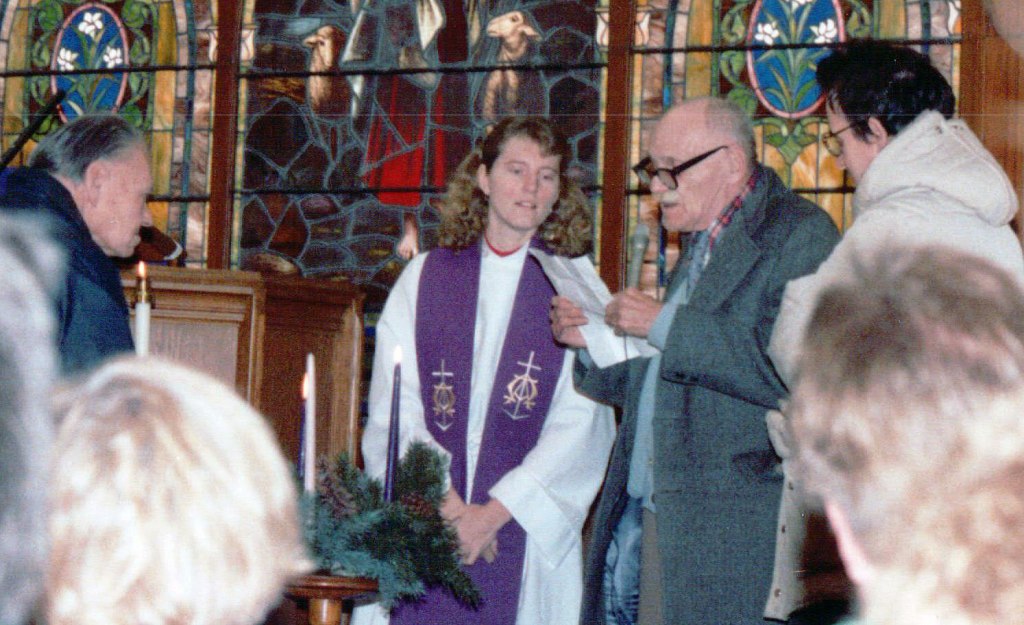
As the congregation finished singing the recessional hymn, I walked down the aisle toward the open sanctuary door and took my place just inside. I smoothed my white robe, adjusted the cincture, and made sure the stole hung evenly around my neck. This was my first Sunday as the associate pastor. I needed to look presentable. Ready, I waited for the last “Amen,” which in every Methodist Church triggers a stampede to coffee hour.
One by one, the parishioners filed past, with words of welcome, hugs, handshakes, and the inevitable sharing of germs.
A finger poked my arm. It poked again. “Miss. Miss.” I turned toward the voice. “Miss, are you that new lady minister?”
Befuddled, I answered, “Yes, my name is Laura. What’s your name?
“Eddie. Eddie Totten.”
I stuck out my hand to shake his. The man next to him shook it instead.
“Her. Herb. Herbie,” he said.
“Nice to meet you, Eddie and Herbie. And your name is?” I turned toward a third man, obviously with the other two. He reached into the pocket of his flannel shirt, retrieved a small notebook, and scribbled in block letters. Then he turned the page toward me. “John. Your name is John.” He nodded and a small sound emanated from his throat. Seeing a line growing impatient behind them, I said, “You know, guys, I hear there’s going to be cake at coffee hour today. How about you head that way so you don’t miss it, and I’ll catch up with you in a few?”
Eddie grinned, and his eyes sparkled. The guys nodded, then headed out the door.
“Those men live in the group home down the street. They’ve come here every Sunday for years,” the next parishioner in line explained.
“They seem sweet.”
“Oh, they are. We all adore them. And it looks like they’ve taken a shine to you already.”
After the last congregant made a beeline for snacks, I headed to my office, removed my clerical garb and wandered to the fellowship hall in search of a much-needed caffeine fix. It took 10 minutes to get near the urn as one person after another pried for personal information.
“Where were you born?
“Brooklyn, but I grew up on Long Island.”
“Just how old are you?”
“27 in two weeks.”
“Any family or significant other around?”
“Excuse me. I promised someone cake.”
Grabbing a large plate, I balanced four slices and my coffee, then headed for my new friends. “Thought you might like a second piece.” I doled out the cake on the plates the guys were still holding.
Eddie, a short, pudgy man in his sixties, spoke with his mouth full. “The fair is coming.”
“A county fair? I’ve never been to one.”
“It, it, it’s fun,” Herbie, the oldest, said, his nose and mustache wiggling as he spoke.
John reached for his notebook. “GO?”
“You want to go to the fair?” All three nodded. “How about I check with the person who runs your home and see if I could take you?”
Of course, she said yes.
The following Sunday, the guys stopped by my office as I was getting ready for the service. Placing a marble in my hand, Eddie said, “For you.” The Sunday after that, they brought me an artificial flower and the next week a tiny plastic puppy. Since their residence was only two doors away across from Sweet’s Funeral Home, I strolled over to see their house mother.
“Herbie, Eddie and John keep bringing me presents. They shouldn’t be doing that.”
Sharon put me straight. “Please don’t ask them to stop. It’s difficult to find things to keep the men entertained. For the last few Saturday mornings, I’ve taken the house-full of them in the van to go yard-sale-ing. All the guys help Eddie figure out what to buy with his nickel, and he brings it to you on Sunday. Just say thank you.”
The shelf behind my desk filled up as we got closer to County Fair week. Finally, the day came. Since they wanted to see the lights at night in the carnival midway, I picked them up at 3 pm. Herbie, the tallest, rode in the front seat. He chatted about what he saw as we drove north. When I checked on Eddie and John in the rear-view mirror, they were sporting enormous grins. “You like to look out the window?”
“The trees are pretty,” Eddie said. He’d been in various institutions all his life and likely had not gone for too many rides. Herbie and John, too. Luckily, they’d been placed in Sharon’s group-home as older adults, where they could live in an actual house.
“I like the river,” Herbie said, “And all them flowers in people’s yards.”
“Look! Look at them rides!” Eddie said as we pulled into the parking lot at the fairgrounds. “Can I ride the bumpy cars?”
“Of course you can,” I said as I parked. “Okay, everybody out. Time to see the fair.” Before going through the gate, I handed each of the guys a slip of paper with my name on it. “Put this in your pocket. If we get separated, give it to a policeman and they will help us find each other.” Each guy dutifully stashed his note. “Okay, what do you want to see first?”
We headed toward a row of barns housing farm animals. We mooed at every cow, petted every horse, and grunted at every pig.
“I want to find the one with the curliest tail,” Herbie said.
John walked over to a pen, wiggled his forefinger and grunted.
“What do you think, guys? Has John found the pig with the curliest tail?”
All three nodded.
Our next stop was a row of pavilions, where businesses showcased their services. We ran our hands over textured roofing tiles, took turns sitting on a riding mower, massaged our palms in hot tub jet spray, sniffed Avon perfumes, and tasted samples of chocolate, jellies and chip dips.
Before we left, we stopped to marvel at a faucet suspended in midair, out of which flowed a constant stream of water. “How do they do that?” Eddie asked.
I shrugged. “Cool, isn’t it?
On the way to the Community building, we stopped to vroom, vroom on the tractors and measure ourselves against the one with tires taller than any of us. Then we joined a circle of folks watching a man juggling while riding a unicycle.
“I wish I could do that,” Eddie said.
“Me, too,” I mumbled. “It looks like fun.”
The Community building housed dioramas about farming made by the local 4H, potted plants and fancy vegetables from the gardening club, displays of handcrafts on tables and homemade quilts on the walls. There was even a gallery of children’s artwork. We explored everything: the biggest pumpkin, the scariest drawing, the most colorful quilt, even the model explaining how to sheer a sheep. Since Eddie thought the wool felt soft, we all had to touch it.
“Pastor Laura. I thought that was you.” The voice came from behind. I turned to find a parishioner, waiting for his wife to finish admiring the quilts. “I’d like to know what you thought of the conversation at the Trustees meeting last Thursday…”
Dutifully, I listened to him drone on about contractor bids for sealing the parking lot until his wife rescued me.
Turning back toward the guys, I said, “You ready to go on some rides?” Herbie and John nodded. “Where’s Eddie?” I did a quick recon of the vast room. “Where’s Eddie? Did either of you see him walk away?” They shook their heads. I walked the guys outside to look.
Over the loudspeaker I heard, “Laura Bender. Laura Bender. Please meet your party at the missing children’s booth.” The guys stayed close as we hurried to find our missing friend.
“I’m Laura Bender,” I said to the security guard standing in the doorway.
“Your guy is in there.” He pointed over his shoulder with his thumb.
I rushed in to find Eddie, sitting on a bench licking a lollipop.
“There you are! I was so worried. Where did you go?”
“You were talking to that man and I smelled something good. Real good. I started sniffing. And I went where I sniffed. And then, I couldn’t find you.” A tear rolled down his cheek. “Am I in trouble?”
“Of course not, Eddie. You did exactly what I asked you to do if we got separated. Come with us. We’re heading to the rides. You want to try the bumpy cars, don’t you?”
Eddie wiped his eyes. After hugs all around, we headed across the fairgrounds, all four of us instinctively holding hands so we wouldn’t get lost. “Who would like some cotton candy before we take rides?”
As if on cue, the neon lights came on in the midway and we spent the next hour admiring them from high atop the Ferris wheel, as we went round and round on the carousel, and not at all while we focused on knocking into each other in the bumper cars. At 10 pm I dropped the guys at their home, then drove to my apartment exhausted and grinning.
The next Sunday, Eddie brought me a golf pencil bearing a roofing company logo and a tiny porcelain bunny looking into a blue basket minus the handle.
“The fair will be back next year,” Herbie said. “You gonna take us?”
John wrote in his notebook, then handed it to me. “You want to be a policeman, John?” He grinned and nodded. “That’s a good idea. That policeman really helped us find Eddie. Maybe we’ll see him at the fair next summer, too.”
Over the following fifty-one weeks, my shelf and then the bottom drawer of the desk filled up with gifts. And every week the guys asked about the fair. Even when they had to trudge through knee deep snow to get to church, they still asked.
“Guess what’s happening this week, guys?” I asked when I saw them approach my office one Sunday in August.
“The, the the Fair?” Herbie asked.
“Yup. I’m picking you up at 3 pm Thursday, if you want to go…” They all hugged me at once. The truth is, I didn’t know who was looking forward to it more, them or me.
For four years in a row, Herbie, Eddie, John and I kept our August fair date. Then the following June, my phone rang early in the morning. It was the church secretary. “I just got word that Herbie Klingsohr died last night. Just wanted to give you a heads-up. You’ve got a funeral.”
I called Sharon to let her know I was coming to see her houseful of guys. When I arrived, they were sitting in a circle in the living room. Eddie slumped in his chair, sniffling.
Sharon introduced me. “This is Reverend Laura from the church down the street. She wants to talk with you about our dear Herbie.”
After expressing condolences, I asked if anyone had ever been to a funeral. Most raised their hands. “We’re going to have a funeral for Herbie on Wednesday. My job is to help us do that well. When someone dies, I always talk with their family members before I prepare. Since you are Herbie’s family, in a minute, I am going to ask you what you liked most about him.” I took out a notebook and pen. “But first, do you have any questions?”
The man directly opposite me raised his hand.
“Go ahead.”
“Can I wear brown shoes?”
“Yes, you can wear brown shoes to the funeral.”
“But I have a blue suit.”
“I’m sure it will look fine with your shoes. Anyone else?”
Another man raised his hand. I nodded to him and he rose from his chair, walked over to the man opposite me and motioned for him to trade seats. Once settled in what became the speaker’s chair, he asked, “Where is Herbie now?”
“Herbie is in heaven with God.”
He scrunched his face. “I thought Herbie was across the street at Sweet’s Funeral Home.”
“Well, um, yes. His body is at Sweets.”
“Is he in the freezer?”
“No, Mr. Sweet is probably giving him a haircut and a shave in his workroom right now.”
One by one, the men traded for the speaker’s chair. After an hour, I had a notebook full of happy thoughts about Herbie and had answered many oddly related questions.
Eddie spoke last. “He was the best roommate ever.” He wiped his nose on his sleeve. “You wanna see our room?” I followed him down a narrow hallway. The small room housed two single beds on opposite walls, separated by two dressers, one with a mirror and the other under a window. Tidy, it held only a few personal items. A small cross sat on Herbie’s dresser.
“Eddie, I know you know the Lord’s prayer. Would you like to lead it at the funeral? Do you think you could do that for Herbie?”
He nodded, then wiped his eyes.
That Wednesday, the church parking lot filled quickly. Parishioners even took off from work to be there. Sharon and her guys sat in the first two rows, the ones reserved for family.
We sang a hymn, read scripture, and then I gave the eulogy, which in Greek means “good word.” There were plenty to offer for Herbie. The guys saw to that. Then it was Eddie’s turn to lead us in the Lord’s prayer. I invited him to come forward and stand next to me. I placed my hand on his shoulder. “Okay, Eddie.”
He took a deep breath. “Our Father, who art in Heaven, hallowed be thy name.” Tears flowed from his eyes. “Thy kingdom come; thy will be done…” He gasped, then let out a wail. I hugged him as he wept. Over his crying, I heard sniffles and snorts from the congregation as they, too, lost their composure. When Eddie was ready, we finished the prayer in unison.
John and Eddie rode to the graveyard in my car, sitting in the back as usual. Herbie’s seat remained empty. It was our version of the “missing man formation.” When the hearse arrived, we exited the car and followed the coffin to the grave. The guys held my hands as we walked and remained close as I led the Liturgy of Committal. Then, one by one, the parishioners returned to their cars and drove away. Sharon gathered the rest of Herbie’s housemates into the van and headed home. Only Eddie, John, and I remained.
“Herbie’s gone to his home, guys. Time for us to head to ours.” Eddie and John used the handkerchiefs Sharon had given them to wipe their faces. Then we turned and headed for my car.
John let himself into the backseat. Eddie chose the front passenger seat. Herbie’s seat.
“Are you still gonna take us to the fair?” Eddie asked.
“I wouldn’t miss it, guys. I love going to the fair with you.”
Eddie’s eyes twinkled. “We have an empty seat now.” In the rearview mirror, I could see John nodding.
“Would you like to choose someone else to go with us? Since we have a vacant seat.”
“We’ll find someone,” Eddie said.
And they did. But that August, we attended our last fair together. The following winter, the bishop assigned me to a different church. It was a tearful goodbye.
In the thirty years since I last saw the guys, I’ve never missed a county fair. I visit every booth, taste test the yummy stuff, search for the pig with the curliest tail and delight at how the lights in the midway brighten the darkness. And every year I pass by the lost children’s booth and remember how one was found by Herbie, Eddie and John.