This is your fault. Well, maybe not yours in particular, but over the years enough people have told me I should write down whatever story I was telling them, I’ve decided to do it. Perhaps I am ill-advised. No matter. Bad advice often leads to interesting stories.
In the next few days, many of us will gather with extended family to celebrate the holidays. For some, this will be a joyous occasion filled with laughter, stories, good food and the chance to relax with people they love.
Others will spend quality time with relatives who insist on indulging in a favorite addiction, sharing polarizing political views, or displaying gross disrespect at high volume. Since choking the living daylights out of these people will likely displease the host who compelled you to attend the annual installment of the family drama, here are some ways to make it from hors d’oeuvres to dessert without police intervention:
All adult relationships are voluntary. No matter how much your family pleads with you to attend the festivities, you can choose to stay away. You can also choose to manage your attendance by reducing the time you are there, staying in a hotel room if it requires an overnight, or taking a walk with a relative whose company you cherish.
You don’t have to attend every argument to which you are invited. When someone tries to goad you by expressing opinions with which you disagree, you don’t have to respond. Walk away, change the subject, have a bathroom emergency, or simply say, “I’m not going to talk about that today.”
Watch out for HATS. That applies to both you and your relatives. HATS, an acronym for Hungry, Angry, Tired or Sick, describes the times when it is not a good idea to engage in any important communication. When you are “HATS,” you should not talk about your in-laws with your spouse, discuss work challenges with your supervisor, negotiate with roommates about chores, or try to register your vehicle. You should definitely not show up that way to holiday gatherings with extended family. If HATS is an issue for an otherwise pleasant family member, bring them a plate of food, an aspirin or suggest a nap. That might be all they need.
The shortest distance between despair and hope is often a good night’s sleep. To follow on the HATS issue, make sure you are well rested before you attend.
To forgive is to set a prisoner free, only to realize you were the prisoner. This doesn’t mean you must condone or minimize bad behavior. It also doesn’t mean you must reestablish a relationship with the person who hurt you. To forgive is to release yourself, not the perpetrator, from the harm done to you. Forgiveness may also be described as “giving up all hope of a better past.” That might sound silly—who hopes for a better past? But how often do we recount the same old hurts, as if one day the ending will somehow come out better? To forgive is to let that story go, and allow new stories to blossom in its place.
If you are grieving and someone says something like “God needed another angel,” or “She’s in a better place,” or “God never gives you more than you can handle,” here is the translation: “I’m clueless and uncomfortable about what to say, but I care and I’m sorry.”
Hurt people, hurt people. If you think back on your last few family gatherings and realize you were the one who created the tension, this might be the year to be a no show. It’s better to miss an event than to make everyone else wish you had. Then spend the time before the next gathering taking care of yourself. Go to therapy or rehab. Apologize. Learn to let others have an opinion you don’t feel the need to refute. Take meds if necessary. You don’t get extra points in life by toughing it out and making yourself and everyone around you miserable. You deserve a better life and so does your family.
This year, may you not only survive the family gathering, may you seek and find the hidden joys in the midst of it.
A friend sent me a cartoon that, as she intended, gave me a good laugh. It was a drawing of a woman standing behind a table with the contents of her purse strewn across its surface. She had a look of panic on her face and a cell phone stuck between her shoulder and ear. “I have to hang up. I’ve misplaced my phone. I can’t find it anywhere!”
Of course, I laughed. I’ve had lots of experience with this problem. Where are my sunglasses? (top of my head) Where is the house key? (doorknob) Where is my ID? (Check the other pocket)
While it’s frustrating to search for an object that should be close at hand and often still is, it can be distressing when what we’ve lost sight of is an intangible. Hope, for instance, or God’s love. The peace that passes all understanding or God’s call on our life. Self-worth, grace or God’s providence. Faith.
One night, it happened to me. I woke from a sound sleep. Something had touched off a chattering of worries inside my head and soon I was in a panic.
What if this or that happened? What would I do? How would I get by? The questions swirled and danced and escalated my brain into a tizzy. The tossing and turning woke my husband.
“What’s the matter this time?” he asked.
“I dunno. I was just worrying.”
“Are the Four Horsemen of the Apocalypse in the driveway yet?”
I sat up and peered out the window into the darkness.
“Nope.”
“Then go back to sleep. God has your back.”
I knew that. In fact, I rely on it. But for a moment it had slipped out of my vision, like the gloves I went searching for the other day and couldn’t find until I looked down at my hands. I had been wearing them all along.
“…when I awake, I am still with you.” Psalm 139:18
My grandmother lived two doors away when I was seven. I loved to visit and did so often. One afternoon, on her way to town, my mother pulled up in front of Nana’s mailbox. “Get in,” she shouted.
I walked to the passenger side of the car. “Wait, I forgot something.” I ran back to the stoop. My retrieval only delayed us a few seconds. Then I got in the car and we took off toward town.
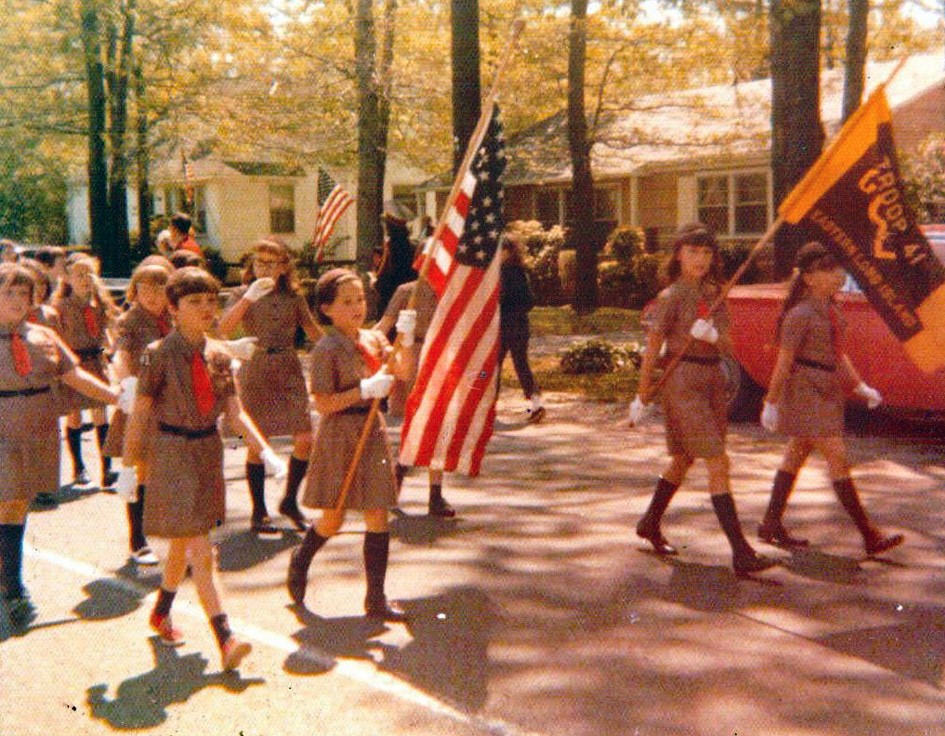
My mother was not happy with me. Why couldn’t I have been ready when she wanted to go? Why did I have to go back and get… whatever it was I’d left on the stoop? I always made her late, she said. My mother was in full tirade when we reached Five Corners. We turned left on Hawkins Avenue, then a few blocks later took Ronkonkoma Avenue when it branched off to the right. In the triangular-shaped piece of land created where the road forked was a small Veteran’s Park. My Brownie troop laid a wreath there every Memorial Day. I smiled, remembering how much I enjoyed being part of that ceremony with all those people in uniform who took care of us.
When we reached the intersection with Portion Road, we stopped for the traffic light. Ours was the second car in line. Impatient to get wherever we were going, my mother complained. “It’s your fault. If only you had been ready on time.”
When the light changed, the car ahead of us proceeded into the intersection. A vehicle running through the red light impacted it on the driver’s side, crushing the woman at the wheel.
Years later, I attended a Yankee game in New York City during Fleet Week. A woman walked up to me and pointed to the name tag on my summer white uniform.
“Are you from the ship made with the steel from the twin towers?” she asked.
“Yes, I’m the chaplain.”
Her eyes filled with tears as she took off the copper memorial bracelet she’d been wearing. She placed it on my wrist. “Please wear this when the ship is commissioned. It would mean a lot to me to know he is on that ship.”
I asked her about the person whose name was engraved in the metal. “My partner,” she said. “An EMT. We were working together at the towers on 9/11. I went to the right, and he went to the left as the building collapsed. I never saw him again.”
The question is begged by the reality. How is the future determined? Is it by the fickle finger of fate? The playing out of a divine scenario or the laws of physics? Is it by an object left on the stoop, a few seconds of time, or the decision to turn one way and not the other? And how is our path directed? By the laying of a wreath, a difficult mother, a commitment to serve, or the need to ask these questions and seek an answer? How does it all come together? So many questions; not enough answers.
In the Valley of Elah, two armies faced one another: the army of the Philistines, and the army of the living God. From among the Philistines, a booming voice raised a challenge: “Choose a man for yourselves and let him come down to me.” When the Israelites saw Goliath, the source of that challenge, they were overcome with fear. Before them stood a man of formidable size and power clad in armor made to protect him from all harm – a conventional warrior on steroids.
When young David appeared at the line of battle, he asked a strategic question his tactically focused brothers had yet to discern. Other than being large and loud, “who is this uncircumcised Philistine that he should defy the armies of the living God?”
“Let no one’s heart fail because of him; your servant will go and fight with this Philistine,” David proclaimed. And despite protests from the king on down, that’s what he did. Abandoning the burdensome armor and conventional weaponry of his day, David faced off against Goliath with the tools with which he was most adept: a slingshot and a bag containing 5 smooth stones–four more than he needed. But he wasn’t armed with just a shepherd’s weapon. David faced his opponent with something his adversary was lacking, and his brother’s army had forgotten—the knowledge that the battle belongs to the Lord. And with faith in the living God, David fought and prevailed.
Years ago, I had the honor of meeting some of the fiercest fighters of the Marine Corps. Men who had faced off against a brutal enemy – not in the Valley of Elah, but in places with names like Tulagi, Tasimboko, Guadalcanal, New Georgia and bloody Edson’s Ridge. An elite force trained to close with and destroy the enemy, Edson’s Raiders, like David, put off the heavy armor and weaponry of their day, preferring instead the tools that made them agile, yet effective. At first, the idea of Raiders infiltrating and overcoming the enemy in unconventional ways met with resistance, but the proof, as they say, is in the pudding. Like David, their small force felled great giants and not only affected the outcome of the war, but created a model which has become the forbearer of today’s special operations units. Their legacy of courage and competence set the standard of what it means to be a Marine. It also set a standard of what it means to be a person of faith—a soldier of God trained to overcome the enemy in whatever form he presents himself.
To David, the enemy was a loudmouth, uncircumcised Philistine, intent on demoralizing God’s people. For Edson’s Raiders, evil manifested itself in those wearing the cloth of nations opposed to freedom and democracy and devoted to tyranny.
Today, the enemy is more elusive and many of us are afraid to even point in his direction for fear we might offend. Day by day he gains a stronger foothold, cajoling us to lower our standards, convincing us our values are antiquated, our faith is impotent, and our God is irrelevant. The loud and persuasive taunts of today’s Philistines are making many hearts weaken nigh unto failing.
And so today, more than ever, we need a David. We need an Edson Raider. We need those who will put on the whole armor of God and meet the enemy in battle. We need those who are not afraid because they know the battle belongs to the Lord. Are you ready?
Thanks to David L. Robbins, the Mighty Pen, the Virginia War Memorial and the Virgina Repertory Theatre for the opportunity to see our plays produced. My play is called “Living on a Prayer.”
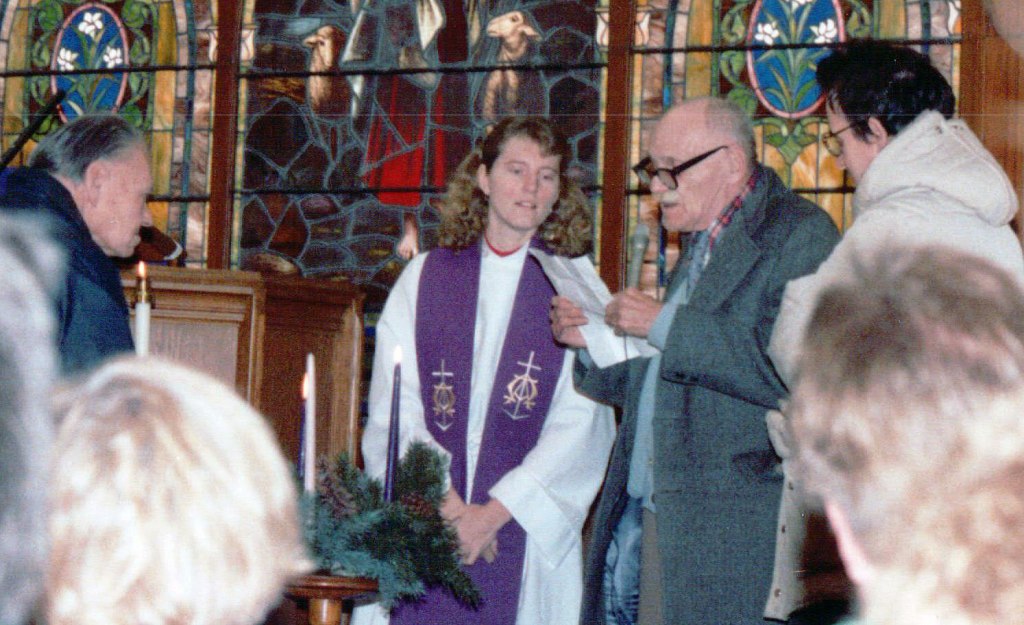
As the congregation finished singing the recessional hymn, I walked down the aisle toward the open sanctuary door and took my place just inside. I smoothed my white robe, adjusted the cincture, and made sure the stole hung evenly around my neck. This was my first Sunday as the associate pastor. I needed to look presentable. Ready, I waited for the last “Amen,” which in every Methodist Church triggers a stampede to coffee hour.
One by one, the parishioners filed past, with words of welcome, hugs, handshakes, and the inevitable sharing of germs.
A finger poked my arm. It poked again. “Miss. Miss.” I turned toward the voice. “Miss, are you that new lady minister?”
Befuddled, I answered, “Yes, my name is Laura. What’s your name?
“Eddie. Eddie Totten.”
I stuck out my hand to shake his. The man next to him shook it instead.
“Her. Herb. Herbie,” he said.
“Nice to meet you, Eddie and Herbie. And your name is?” I turned toward a third man, obviously with the other two. He reached into the pocket of his flannel shirt, retrieved a small notebook, and scribbled in block letters. Then he turned the page toward me. “John. Your name is John.” He nodded and a small sound emanated from his throat. Seeing a line growing impatient behind them, I said, “You know, guys, I hear there’s going to be cake at coffee hour today. How about you head that way so you don’t miss it, and I’ll catch up with you in a few?”
Eddie grinned, and his eyes sparkled. The guys nodded, then headed out the door.
“Those men live in the group home down the street. They’ve come here every Sunday for years,” the next parishioner in line explained.
“They seem sweet.”
“Oh, they are. We all adore them. And it looks like they’ve taken a shine to you already.”
After the last congregant made a beeline for snacks, I headed to my office, removed my clerical garb and wandered to the fellowship hall in search of a much-needed caffeine fix. It took 10 minutes to get near the urn as one person after another pried for personal information.
“Where were you born?
“Brooklyn, but I grew up on Long Island.”
“Just how old are you?”
“27 in two weeks.”
“Any family or significant other around?”
“Excuse me. I promised someone cake.”
Grabbing a large plate, I balanced four slices and my coffee, then headed for my new friends. “Thought you might like a second piece.” I doled out the cake on the plates the guys were still holding.
Eddie, a short, pudgy man in his sixties, spoke with his mouth full. “The fair is coming.”
“A county fair? I’ve never been to one.”
“It, it, it’s fun,” Herbie, the oldest, said, his nose and mustache wiggling as he spoke.
John reached for his notebook. “GO?”
“You want to go to the fair?” All three nodded. “How about I check with the person who runs your home and see if I could take you?”
Of course, she said yes.
The following Sunday, the guys stopped by my office as I was getting ready for the service. Placing a marble in my hand, Eddie said, “For you.” The Sunday after that, they brought me an artificial flower and the next week a tiny plastic puppy. Since their residence was only two doors away across from Sweet’s Funeral Home, I strolled over to see their house mother.
“Herbie, Eddie and John keep bringing me presents. They shouldn’t be doing that.”
Sharon put me straight. “Please don’t ask them to stop. It’s difficult to find things to keep the men entertained. For the last few Saturday mornings, I’ve taken the house-full of them in the van to go yard-sale-ing. All the guys help Eddie figure out what to buy with his nickel, and he brings it to you on Sunday. Just say thank you.”
The shelf behind my desk filled up as we got closer to County Fair week. Finally, the day came. Since they wanted to see the lights at night in the carnival midway, I picked them up at 3 pm. Herbie, the tallest, rode in the front seat. He chatted about what he saw as we drove north. When I checked on Eddie and John in the rear-view mirror, they were sporting enormous grins. “You like to look out the window?”
“The trees are pretty,” Eddie said. He’d been in various institutions all his life and likely had not gone for too many rides. Herbie and John, too. Luckily, they’d been placed in Sharon’s group-home as older adults, where they could live in an actual house.
“I like the river,” Herbie said, “And all them flowers in people’s yards.”
“Look! Look at them rides!” Eddie said as we pulled into the parking lot at the fairgrounds. “Can I ride the bumpy cars?”
“Of course you can,” I said as I parked. “Okay, everybody out. Time to see the fair.” Before going through the gate, I handed each of the guys a slip of paper with my name on it. “Put this in your pocket. If we get separated, give it to a policeman and they will help us find each other.” Each guy dutifully stashed his note. “Okay, what do you want to see first?”
We headed toward a row of barns housing farm animals. We mooed at every cow, petted every horse, and grunted at every pig.
“I want to find the one with the curliest tail,” Herbie said.
John walked over to a pen, wiggled his forefinger and grunted.
“What do you think, guys? Has John found the pig with the curliest tail?”
All three nodded.
Our next stop was a row of pavilions, where businesses showcased their services. We ran our hands over textured roofing tiles, took turns sitting on a riding mower, massaged our palms in hot tub jet spray, sniffed Avon perfumes, and tasted samples of chocolate, jellies and chip dips.
Before we left, we stopped to marvel at a faucet suspended in midair, out of which flowed a constant stream of water. “How do they do that?” Eddie asked.
I shrugged. “Cool, isn’t it?
On the way to the Community building, we stopped to vroom, vroom on the tractors and measure ourselves against the one with tires taller than any of us. Then we joined a circle of folks watching a man juggling while riding a unicycle.
“I wish I could do that,” Eddie said.
“Me, too,” I mumbled. “It looks like fun.”
The Community building housed dioramas about farming made by the local 4H, potted plants and fancy vegetables from the gardening club, displays of handcrafts on tables and homemade quilts on the walls. There was even a gallery of children’s artwork. We explored everything: the biggest pumpkin, the scariest drawing, the most colorful quilt, even the model explaining how to sheer a sheep. Since Eddie thought the wool felt soft, we all had to touch it.
“Pastor Laura. I thought that was you.” The voice came from behind. I turned to find a parishioner, waiting for his wife to finish admiring the quilts. “I’d like to know what you thought of the conversation at the Trustees meeting last Thursday…”
Dutifully, I listened to him drone on about contractor bids for sealing the parking lot until his wife rescued me.
Turning back toward the guys, I said, “You ready to go on some rides?” Herbie and John nodded. “Where’s Eddie?” I did a quick recon of the vast room. “Where’s Eddie? Did either of you see him walk away?” They shook their heads. I walked the guys outside to look.
Over the loudspeaker I heard, “Laura Bender. Laura Bender. Please meet your party at the missing children’s booth.” The guys stayed close as we hurried to find our missing friend.
“I’m Laura Bender,” I said to the security guard standing in the doorway.
“Your guy is in there.” He pointed over his shoulder with his thumb.
I rushed in to find Eddie, sitting on a bench licking a lollipop.
“There you are! I was so worried. Where did you go?”
“You were talking to that man and I smelled something good. Real good. I started sniffing. And I went where I sniffed. And then, I couldn’t find you.” A tear rolled down his cheek. “Am I in trouble?”
“Of course not, Eddie. You did exactly what I asked you to do if we got separated. Come with us. We’re heading to the rides. You want to try the bumpy cars, don’t you?”
Eddie wiped his eyes. After hugs all around, we headed across the fairgrounds, all four of us instinctively holding hands so we wouldn’t get lost. “Who would like some cotton candy before we take rides?”
As if on cue, the neon lights came on in the midway and we spent the next hour admiring them from high atop the Ferris wheel, as we went round and round on the carousel, and not at all while we focused on knocking into each other in the bumper cars. At 10 pm I dropped the guys at their home, then drove to my apartment exhausted and grinning.
The next Sunday, Eddie brought me a golf pencil bearing a roofing company logo and a tiny porcelain bunny looking into a blue basket minus the handle.
“The fair will be back next year,” Herbie said. “You gonna take us?”
John wrote in his notebook, then handed it to me. “You want to be a policeman, John?” He grinned and nodded. “That’s a good idea. That policeman really helped us find Eddie. Maybe we’ll see him at the fair next summer, too.”
Over the following fifty-one weeks, my shelf and then the bottom drawer of the desk filled up with gifts. And every week the guys asked about the fair. Even when they had to trudge through knee deep snow to get to church, they still asked.
“Guess what’s happening this week, guys?” I asked when I saw them approach my office one Sunday in August.
“The, the the Fair?” Herbie asked.
“Yup. I’m picking you up at 3 pm Thursday, if you want to go…” They all hugged me at once. The truth is, I didn’t know who was looking forward to it more, them or me.
For four years in a row, Herbie, Eddie, John and I kept our August fair date. Then the following June, my phone rang early in the morning. It was the church secretary. “I just got word that Herbie Klingsohr died last night. Just wanted to give you a heads-up. You’ve got a funeral.”
I called Sharon to let her know I was coming to see her houseful of guys. When I arrived, they were sitting in a circle in the living room. Eddie slumped in his chair, sniffling.
Sharon introduced me. “This is Reverend Laura from the church down the street. She wants to talk with you about our dear Herbie.”
After expressing condolences, I asked if anyone had ever been to a funeral. Most raised their hands. “We’re going to have a funeral for Herbie on Wednesday. My job is to help us do that well. When someone dies, I always talk with their family members before I prepare. Since you are Herbie’s family, in a minute, I am going to ask you what you liked most about him.” I took out a notebook and pen. “But first, do you have any questions?”
The man directly opposite me raised his hand.
“Go ahead.”
“Can I wear brown shoes?”
“Yes, you can wear brown shoes to the funeral.”
“But I have a blue suit.”
“I’m sure it will look fine with your shoes. Anyone else?”
Another man raised his hand. I nodded to him and he rose from his chair, walked over to the man opposite me and motioned for him to trade seats. Once settled in what became the speaker’s chair, he asked, “Where is Herbie now?”
“Herbie is in heaven with God.”
He scrunched his face. “I thought Herbie was across the street at Sweet’s Funeral Home.”
“Well, um, yes. His body is at Sweets.”
“Is he in the freezer?”
“No, Mr. Sweet is probably giving him a haircut and a shave in his workroom right now.”
One by one, the men traded for the speaker’s chair. After an hour, I had a notebook full of happy thoughts about Herbie and had answered many oddly related questions.
Eddie spoke last. “He was the best roommate ever.” He wiped his nose on his sleeve. “You wanna see our room?” I followed him down a narrow hallway. The small room housed two single beds on opposite walls, separated by two dressers, one with a mirror and the other under a window. Tidy, it held only a few personal items. A small cross sat on Herbie’s dresser.
“Eddie, I know you know the Lord’s prayer. Would you like to lead it at the funeral? Do you think you could do that for Herbie?”
He nodded, then wiped his eyes.
That Wednesday, the church parking lot filled quickly. Parishioners even took off from work to be there. Sharon and her guys sat in the first two rows, the ones reserved for family.
We sang a hymn, read scripture, and then I gave the eulogy, which in Greek means “good word.” There were plenty to offer for Herbie. The guys saw to that. Then it was Eddie’s turn to lead us in the Lord’s prayer. I invited him to come forward and stand next to me. I placed my hand on his shoulder. “Okay, Eddie.”
He took a deep breath. “Our Father, who art in Heaven, hallowed be thy name.” Tears flowed from his eyes. “Thy kingdom come; thy will be done…” He gasped, then let out a wail. I hugged him as he wept. Over his crying, I heard sniffles and snorts from the congregation as they, too, lost their composure. When Eddie was ready, we finished the prayer in unison.
John and Eddie rode to the graveyard in my car, sitting in the back as usual. Herbie’s seat remained empty. It was our version of the “missing man formation.” When the hearse arrived, we exited the car and followed the coffin to the grave. The guys held my hands as we walked and remained close as I led the Liturgy of Committal. Then, one by one, the parishioners returned to their cars and drove away. Sharon gathered the rest of Herbie’s housemates into the van and headed home. Only Eddie, John, and I remained.
“Herbie’s gone to his home, guys. Time for us to head to ours.” Eddie and John used the handkerchiefs Sharon had given them to wipe their faces. Then we turned and headed for my car.
John let himself into the backseat. Eddie chose the front passenger seat. Herbie’s seat.
“Are you still gonna take us to the fair?” Eddie asked.
“I wouldn’t miss it, guys. I love going to the fair with you.”
Eddie’s eyes twinkled. “We have an empty seat now.” In the rearview mirror, I could see John nodding.
“Would you like to choose someone else to go with us? Since we have a vacant seat.”
“We’ll find someone,” Eddie said.
And they did. But that August, we attended our last fair together. The following winter, the bishop assigned me to a different church. It was a tearful goodbye.
In the thirty years since I last saw the guys, I’ve never missed a county fair. I visit every booth, taste test the yummy stuff, search for the pig with the curliest tail and delight at how the lights in the midway brighten the darkness. And every year I pass by the lost children’s booth and remember how one was found by Herbie, Eddie and John.
“Finally, it’s started,” Adriane said to those gathered in a lean-to on the far side of the church building.
“Good, ‘cause I’m freezing,” said Peter. He pulled his long robe tighter.
Over the wind, the sounds of laughter, mingled with the somewhat in-tune singing of Sunday School classes, wafted through the cracked-open back door of the fellowship hall.
Danielle shifted from one cold foot to the other. “It’ll be another forty-five minutes before they bring everyone outside to see our nativity. What do you want to do until then?”
“Hey, quit that,” Adriane said to the goat attached to the leash wrapped twice around her wrist. “Quit humping my leg.”
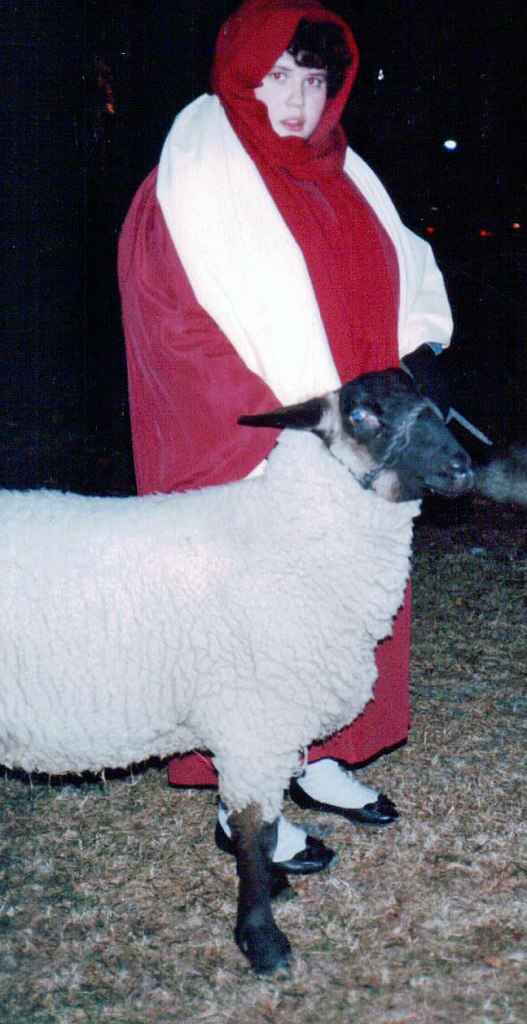
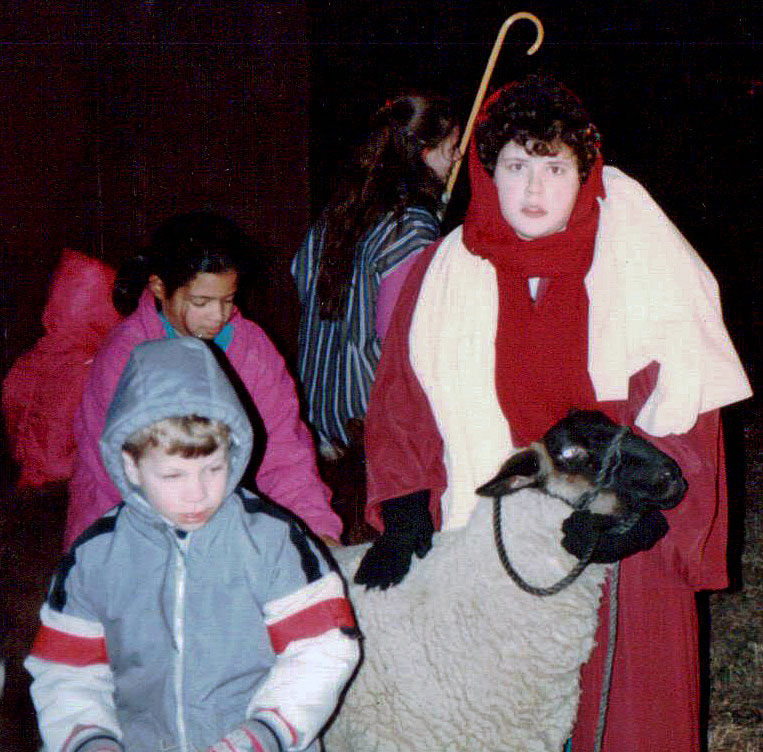
“He only wants to chew on your sleeve,” Heather said, as she patted a wooly ewe on her head.
“This miniature cow is cute,” Ginny said, but she’s restless. “Do you think we could take these guys for a walk? We have plenty of time.”
“If it’ll get this goat off me, I’ll go,” said Adriane.
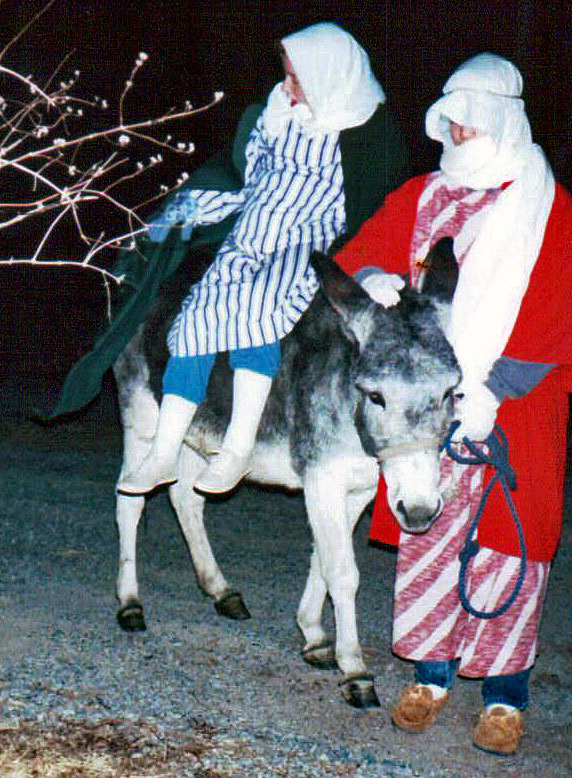
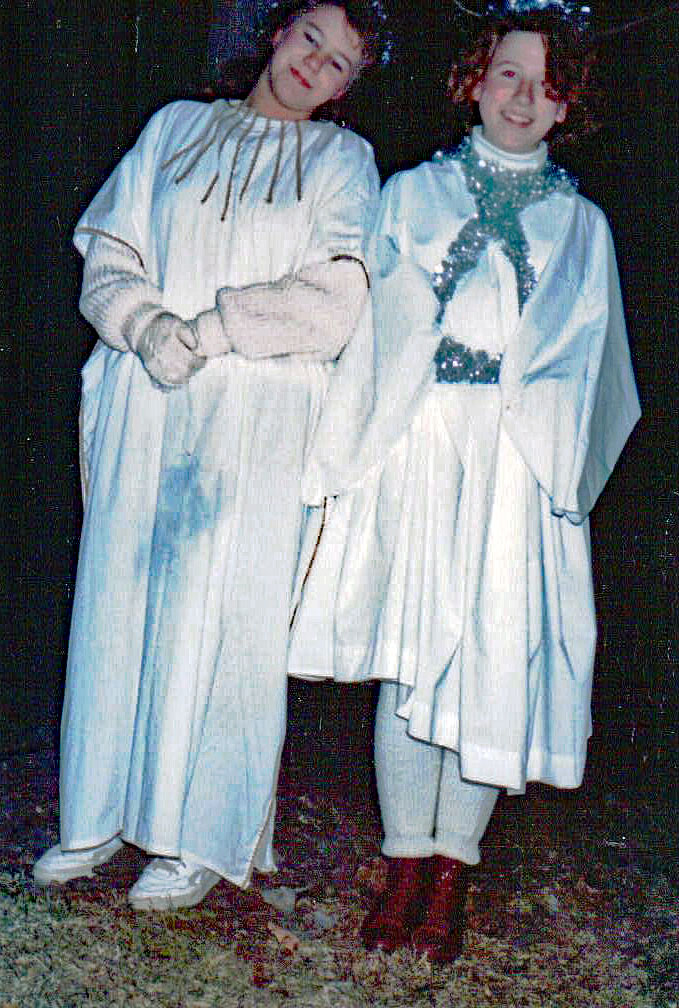
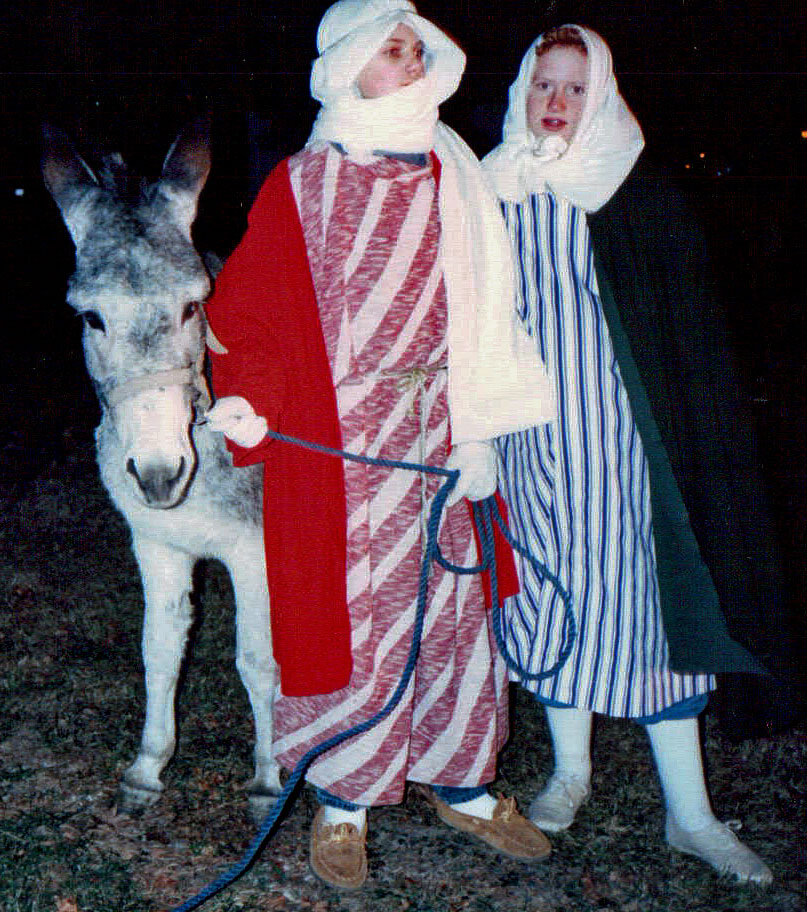
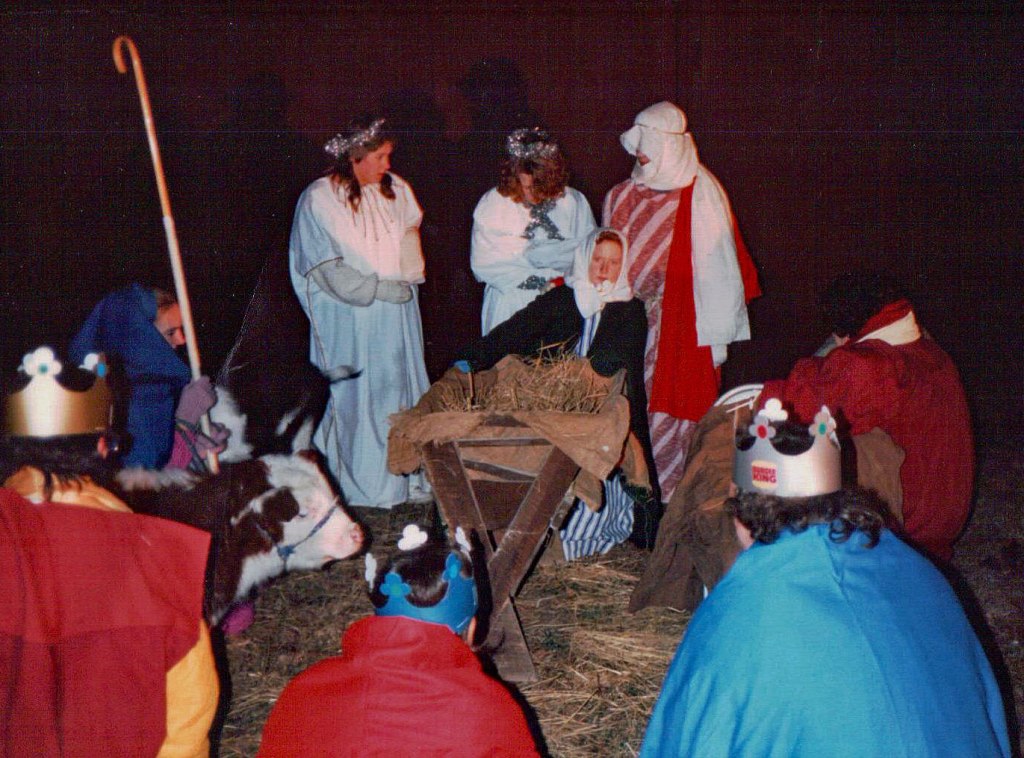
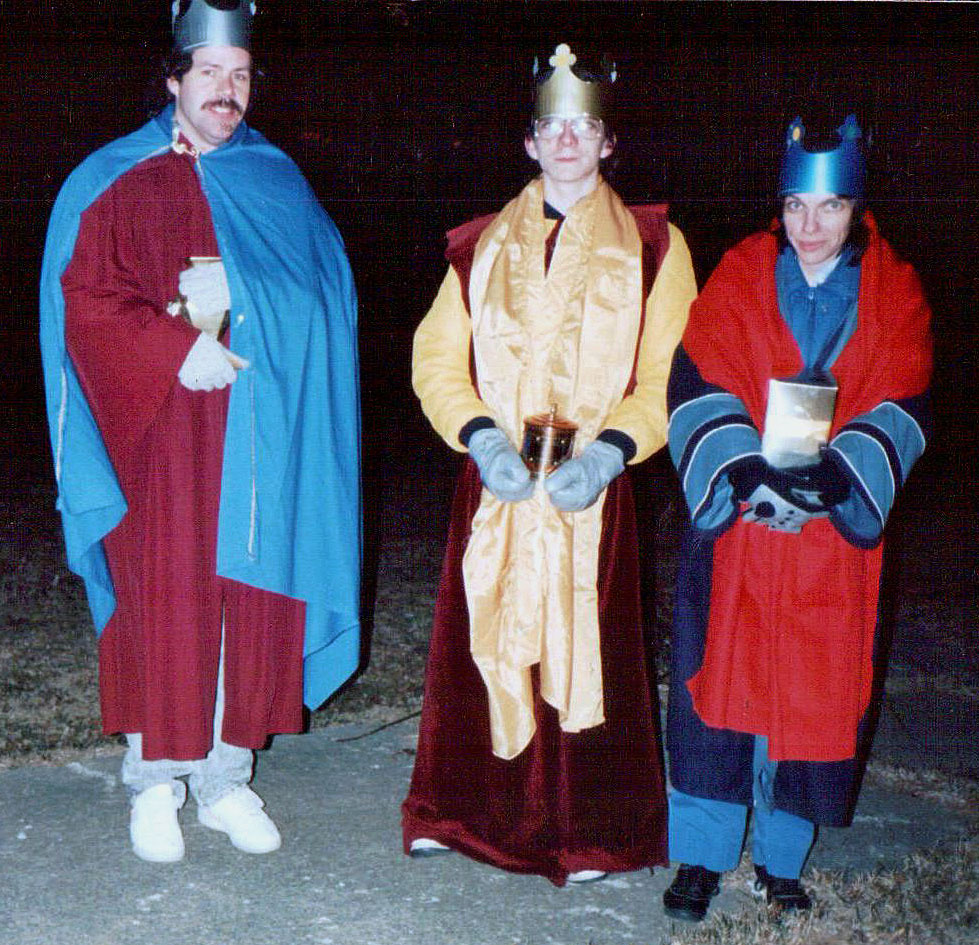
Animals in tow, the group set off down the main road, past the church to the grocery store two blocks away. Mary, Joseph, an angel, two shepherds, three kings, a goat, a donkey, two sheep, and a mini cow circled the perimeter of the parking lot. Before heading back to the church, the teens and their menagerie wandered past the store’s large plate-glass window and waved at those inside.
Lesley looked at her watch. “We’d better get back. The Sunday School presentations are gonna end soon.”
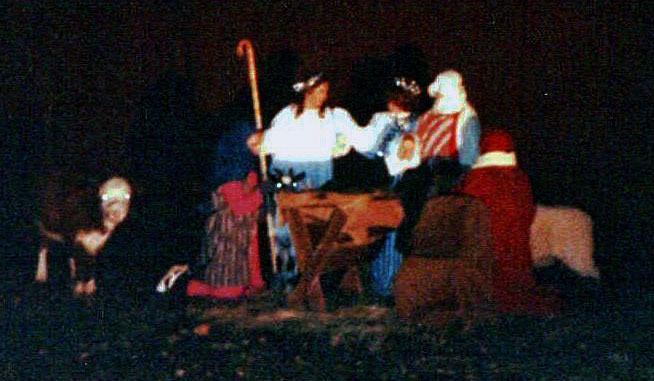
The wandering creche returned just in time to take their places around the manger.
Suddenly, the rear fellowship hall door opened. The teens, in biblical garb, posed on cue as overly excited children dragged their weary parents into the night air.
Two members of the chancel choir broke into song and the crowd joined them. “Away in a manger, no crib for a bed.” “Angels we have heard on high, sweetly singing o’er the plains.”
Parental paparazzi cameras flashed.
During the third hymn, a sixth grader sang “We three kings of orient are, smoking on a rubber cigar.” His father took swift action. “Field and fountain, moor and mountain, following yonder star,” he continued properly.
The trip to the manger ended with the heavenly sounds of Silent Night. All four verses.
The Living Nativity of 1987 was a success.
The next morning, the office phone rang. “You’ve reached the church secretary. How may I help you?”
Without identifying herself, the caller replied, “I think my husband is drinking again. He’s been sober for two years, but last night when he came home from the grocery store, he told me he’d seen an angel leading a cow through the parking lot. Is the pastor available? I need to make an appointment for him.”







 Bender Tales