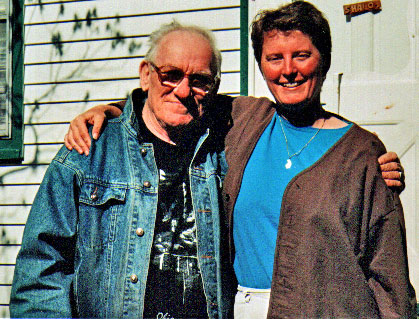
Delivering life changing news requires clarity and guts. The issue doesn’t become less heart wrenching with flowery words, clinical jargon, or gentle hesitations. You just have to say it. Experience taught me that.
Years ago, I got called to the hospital to support an elderly parishioner whose husband had just had a heart attack. Seated alone in the corner of a small waiting room reserved for families of the dying, Edith rose when I entered. We hugged. I held on while she cried. Soon, a young female physician arrived. We turned to hear her deliver a monologue with language appropriate only to her case notes.
Edith tugged on my sleeve. “I don’t understand. What’s she saying?”
“Your husband has died, Edith.”
“Why didn’t she just tell me that?”
A fair question. Receiving life changing news is tough enough without having to struggle to comprehend the message.
As a military chaplain, I taught officers and senior enlisted how to handle a Red Cross message properly. According to instruction, they were to break the news to the recipient, while the chaplain stood by to assist.
“This is what you do,” I’d say. “Find the recipient’s supervisor. Tell them about the message. Have them locate the recipient. When that person arrives, walk them to a semi-private space, like an empty TV lounge. That way, if they have an emotional response, there will be no looky-loos to ask what’s going on. Tell them the command has received a Red Cross message. The message was sent by ______. Your _____ has died. Then stop talking. Let the message sink in. When the recipient is ready, continue with the details. Walk them back to their supervisor who, if the command allows it, should have already started the process for emergency leave.”
Invariably, the only question I’d be asked was “Do we have to use the word ‘died?’ Couldn’t I say ‘passed, is with the angels, or has gone home to God?’”
“Those other phrases don’t make the person less dead. Use died.”
“But that makes me uncomfortable.”
“It’s okay if you’re uncomfortable. So is the recipient. You’re delivering life changing news. Use ‘died,’ unless the message is for injuries, births or some other reason.”
Occasionally, senior NCOs and officers followed my guidance. But most of the time, they’d chicken out, hand it to me and beg me to do it. Truthfully, I preferred it that way. Less mess. And it could get really messy.
Early one Sunday morning, I received a call from the quarterdeck at Marine Corps Base Quantico. A Red Cross message had come in for one of the Marines, and since I had the duty, they needed me to drive in and help with the delivery.
I met the recipient’s Gunny in the barrack’s lobby. Since no one was around to watch us deliver the message, I offered to wait there while the Gunny fetched him.
“It’s okay, chaplain. You can go upstairs, too.”
I followed him to the recipient’s room. The door was closed.
With the side of his fist, the Gunny banged three times. “Corporal, your father is dead. Open the door.” He turned to me. “There you go, chaplain,” he said as he headed for the stairs, leaving me to mop up the distraught Marine.
Just as the deliveries varied, so did the responses. Some recipients expected the news, especially if the family member had been ill for a long time. For others, the news came as a shock – a crib death, a gang shooting or a suicide. Many shed tears, some sat in silence, a petty officer announced, “Good. One less bastard,” then walked away. What I expected each time was to not know what to expect.
Then, after eleven years of being the bearer of mostly bad news, I became the recipient.
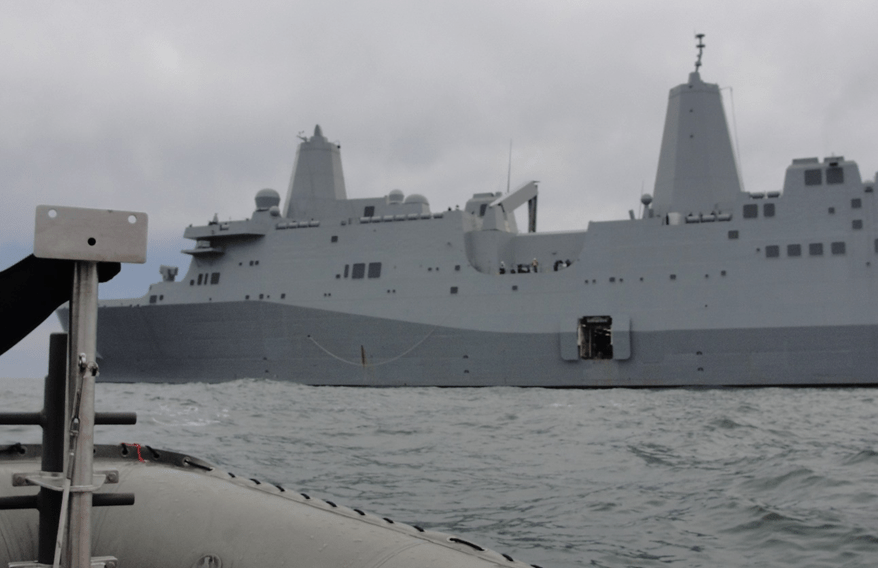
The sun warmed the flight deck of USS New York as I stood near the stern. 16March in Mayport, FL and it already felt like summer. I gripped my cell phone as the ship inched away from the pier.
“I’d like to speak to my father,” I said. I gave the floor nurse his name.
“You’d better call back later. We, uh, we’re… taking care of him right now.”
“I’m a sailor onboard USS New York. Our ship is heading out to sea as we speak. I am his daughter. His only child.”
“Hold on. I’ll see what I can do.” I heard some rustling and unclear conversation. Then she returned. “Okay, I’ll hold the phone to his ear. He’s very weak.”
I don’t remember what I said in our last minute together other than “I love you.” But that was enough. I returned to my stateroom to email Ken. He’d gone to Michigan to visit his family since I would be a few weeks at sea.
“My father is dying. I don’t know if I’ll be able to get to Long Island anytime soon. Could you head there for me?”
Before he could respond, General Quarters sounded. I sped to my assigned post in the medical department. For the next two hours, my assistant and I provided religious support to sailors pretending to die. Since we’d done this for real in the desert, our conversation turned to other things.
“While we’re comforting actors, someone is doing this right now for my father.”
“What are you talking about?”
“My dad’s dying. I’m likely to get a Red Cross message soon. I wonder who’ll draw the short straw and have to tell me.”
“I can think of a few people you wouldn’t want it to be.”
“You got that right.”
After the GQ drill, I stopped by the XO’s office to give him a heads up. He’d not received a message yet, but promised to let me know as soon as it arrived.
After lunch, I walked out to the weather deck to watch the ship’s first MISSLEX. I stood near the CO.
“The XO told me about your father. I’m sorry. If you have to go home, we’ll figure a way to make that happen.” He raised his binoculars to watch the gunner’s first shot at the wooden pallet they’d dropped behind the ship. It missed the target. A second shot came closer.
“Fuck. Cease fire. Cease fire.”
“What happened, Skipper?”
He shook his head and handed me the binoculars. Across the rippled water, a whale playfully tossed the target into the air.
Since no message had arrived, I spent the rest of the afternoon doing what I always did – counseling sailors, shuffling paperwork and writing the evening prayer.
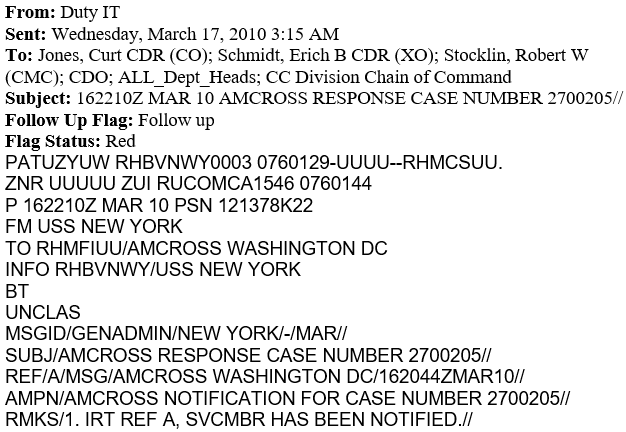
After dinner, I headed back into the wardroom for the evening Operations Brief. The XO met me at the door. He shook his head. “We got the message. Says you father is gravely ill. We’ll call to see if the Marines can send a helo to pick you up tomorrow. Forget about the meeting. Go make plans.”
I headed back to my stateroom. An email from Ken had arrived. “I just talked with your mom at 1825. She’s going to the hospital. Your dad is in a coma. He’s filling up with fluids. It doesn’t look good. I’m going to come home Thursday straight through.”
I emailed back. “Should I fly to our home in VA or my parent’s home in NY? Where are you driving to? The XO says that the Marines can fly out and pick me up.”
While I waited for a response, I searched for a flight from Jacksonville, FL to Long Island, New York. Then the internet went down.
Antsy, I wandered over to see the CO. He’d just returned from the Ops Brief. “The Marines can’t send a helo tomorrow,” he said. “But don’t worry, you’ll be leaving. Just pack and find a flight.”
“Internet’s down, Sir.”
“What else is new? It’ll come back.”
“What are you going to do? Throw me into the sea? We’re 80 miles out.”
“You passed your swim test, right?”
When the internet came back, I found a flight out of JAX to Islip Airport. Then I packed my dress blues, the few civilian clothes I had with me, and my laptop. At 2200, I climbed up to the bridge for evening prayer. In the darkness, I made my way past the duty crew responsible for ship’s movement, and stopped at a small stand next to the 1MC. I pulled the mic off the wall. “Stand by for evening prayer.
Thank you, O God, for this day. Thank you for the air we breathed, for the sunlight that glistened on the water around us, and for the stars that now twinkle high above us. Each day, O God, you surround us with wonders. Each day you fill us with gifts abounding. Help us sharpen our vision, so we can truly see all with which You have blessed us. Today, one of our blessings was a lesson in the art of aiming, as we participated in the ship’s first MISSLEX. Aiming is so important, O God, not only during GUNEXs, but in all we do. In order to reach our goals, in order to become what you have created us to be, we must point our lives in the right direction then, keeping our eye on our objectives, steady our course so we may achieve all that our heart dreams. O God, help us take aim with our lives, so what we become is what you have planned for us. As now we prepare for lights out, we ask for your blessing upon those who stand watch for us this night, both here and at home, and upon Noah Harrison Jr. who was born this morning. We pray all this in your most holy name. AMEN.
I closed with the words both the religious and the non-religious sailors waited for each evening. “Good night, New York.”
“Don’t forget to say that,” I’d been repeatedly reminded. “It’s like hearing our mom tuck us in.”
Once my “kids” were in bed, I returned to my stateroom. The internet was down again. As I organized myself for the morning “swim,” the XO knocked on the door.
“Ken’s on the phone in my office. I’m sorry.”
“Nice superhero pajamas, XO.” I followed him the ten feet from my door to his.
As ombudsman for the ship, Ken knew the ship-to-shore phone number and had figured this was a good time to use it. He confirmed my father had died, and I confirmed my flight plans. “How are you getting back to land?” he asked.
“I’ll let you know after I get there.”
The next morning, my assistant knocked on the door. “The CO says bring your gear. You’re leaving.” He helped me carry my stuff down several decks. We stopped at the open port gangway. I couldn’t see land in any direction.
“Where are we, Sir?” I asked the CO.
“Close enough.”
“I thought we were 80 miles out. How did we get close enough?”
“As CO, I must ensure that my crew is properly trained. It occurred to me last night that I had sailors who had not had enough practice in ship to shore transfers. So, they’ll be practicing on you. Over the side, chaplain.”
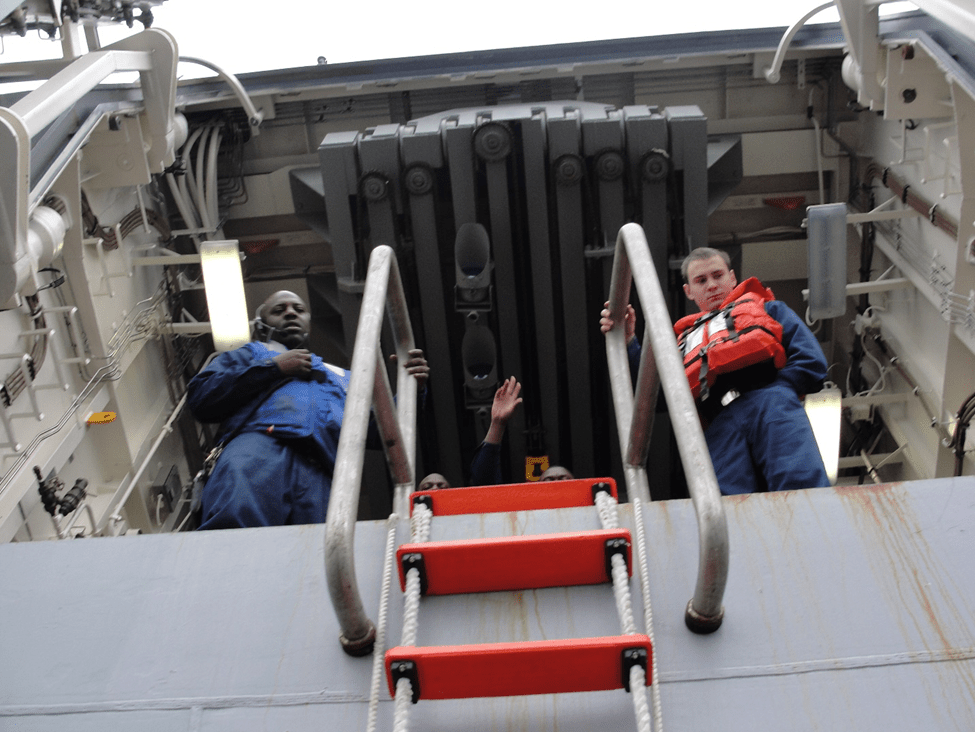
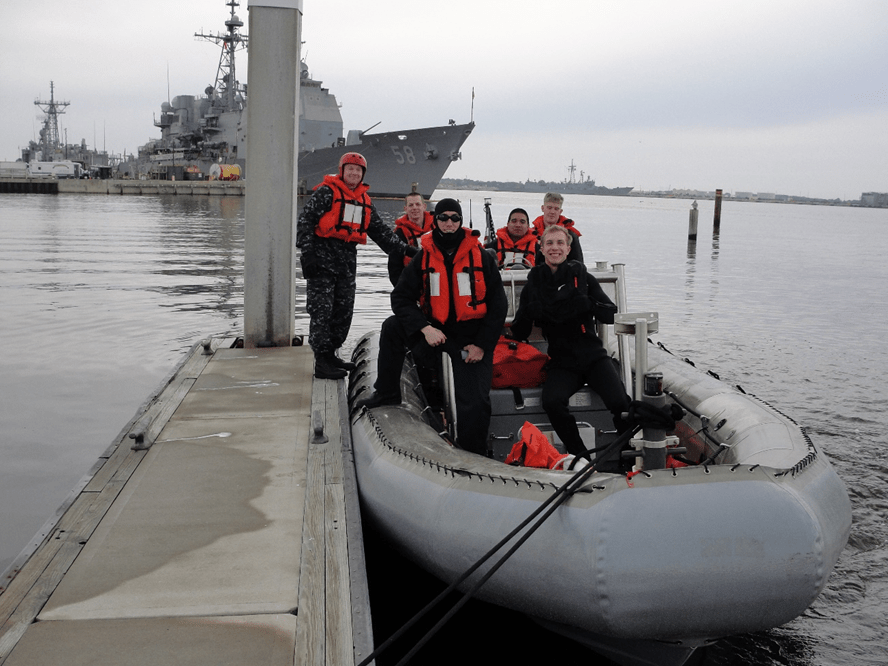
A rope ladder hung down two decks to a RHIB, bouncing furiously on the waves. My assistant lowered my gear to the guys below, then it was my turn. Descending the ladder was easy. Landing in a moving rubber boat was a bit more difficult. Finally seated, with one hand I grabbed hold of an inside rope to steady myself and with the other, I hugged my laptop.
Once we were out of view of the ship, the driver yelled, “Hey Chaps, do you mind if we open it up?”
I turned to the young man next to me. “Are you the rescue swimmer?”
“Yes, Ma’am.”
“Okay, let’s see what it’s got.”
We flew from crest to crest over the waves, slowing only when we neared the shore. By the time we arrived, no part of me was dry.
“We were told to drop you somewhere on base. Is this good?”
In front of us, a twenty-foot pier jutted out near a contractor’s maintenance building.
“This is perfect. Thanks, guys. That was fun!”
“Hey Chaps, why did you need to get to shore? You got something special to do?”
“Yes, my …. Uh, I have to go to… I have an important function to attend. Be careful getting back to the ship, guys.”
“You sound like a mom, Chaps.” They pulled away from the pier.
I guess I wasn’t as comfortable with the phrase “My dad died; I’m going to his funeral,” as I thought.

Copyright © 2026 bendertales.com
 Bender Tales
Such a great story Laura! Great to hear from you! Hope all is well with you and Ken!
Sent from my iPhone
>
LikeLike