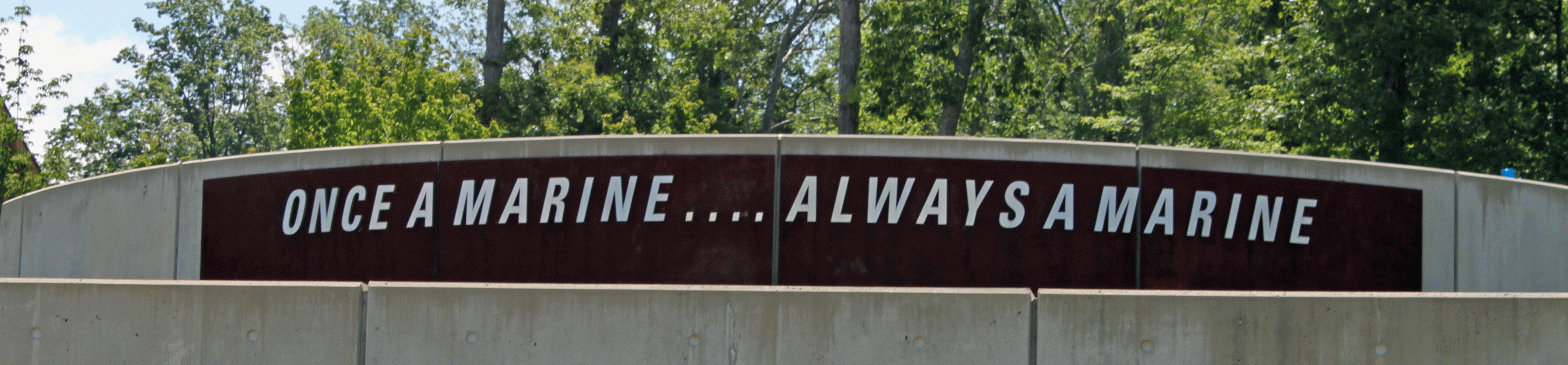
Adlesperger Hall sat atop a steep hill in the wooded area above Butler Stadium on Marine Corps Base Quantico, VA. Named for LCPL Christopher S. Adlesperger, who, while fighting in Fallujah, Iraq, had single-handedly raced up a stairway under fire and cleared a rooftop in order to shield wounded Marines from further harm, the building housed the Marine Corps Wounded Warrior Regiment (WWR).

Unlike the Navy’s Safe Harbor Program, which offered as-needed assistance and resources to wounded, ill or injured Sailors, the Wounded Warrior Regiment was an actual military unit. Marines assigned to the unit were those whose medical issues required extensive hospitalization or intervention and precluded their ability to fill an operational billet. Staff members included active-duty and reserve Marines and Sailors, veterans, military spouses and civilians. The Regiment existed not only to keep a tight hold on those in the recovery process, but to advocate for their needs as fiercely as the Marines executed combat.
As the regimental chaplain, I was responsible for two Wounded Warrior Battalion chaplains, one at Camp Lejeune and the other at Camp Pendleton, as well as the chaplain assigned to the Marine Corps detachment in Landstuhl, Germany. I would have traded my supervisory assignment with any of those chaplains in a heartbeat because they provided consistent, direct care to Marines.
My opportunities to work with wounded, ill and injured (WII) Marines were anything but consistent. I spent Wednesdays at Walter Reed in Bethesda, MD visiting patients and meeting with the families of newly arrived wounded Marines. Tensions were always high in those gatherings as exhausted parents and/or spouses, who had raced across the country after receiving the news, tried to wrap their minds around their Marine’s injuries. Most of the time, these were severe enough to be not only life altering for the Marines but also for their families. I divided the rest of my time between meetings, ceremonies, Warrior Athlete Reconditioning Program (WAR-P) events, and visits to Marine Corps detachments around the country to intervene in the crisis du jour.
Since the Navy had paid for me to get a Masters in Conflict Transformation, they expected me to use it. In Little Rock, Arkansas, I mediated between a wife and a mother with opposing views about the future of their Marine who had been in a coma for a year. Although the Marine died three weeks later, the mother and finally-accepted-daughter-in-law were then able to support each other in their grief. In San Antonio, Texas, the overly anxious family of a severely burned pilot needed a calming influence, and some focused attention during his lengthy stay in the burn ward. In a hospital in Richmond, Virginia, parents who had taken up residence in a waiting room needed to be convinced to go home: Sitting behind a table piled high with loose “tabacky” as they rolled their cigarettes, the dad explained, “If’n our Marine is gonna be here for a few months, we gonna stay, too. ‘Sides, there’s air conditionin’ here. We ain’t got none at home.” Their Marine had had a quadrant of his skull removed and stored in a freezer to take the pressure off his swollen brain. His second biggest concern was having to return to live with his parents if he recovered.
The Wounded Warrior Regiment’s concern was to find the best possible outcome for all their Marines. Most families were ill situated to care for a gravely injured son, daughter, or spouse without major sacrifices. Someone would have to give up their job to become a full-time caregiver. Houses would need to be renovated to accommodate medical needs and equipment. And serious monitoring would need to be done for families where addictions, mental health issues and illegal behaviors ruled the day.
The issues facing Wounded, Ill, and Injured (WII) Marines were complicated, not only during their recovery phase, but long into the future. In the conference room of Adlesperger Hall, our team met daily at 0800 to fight the barriers to health and wholeness in whatever form they presented themselves.
+ + +
“CO’s inbound!” the Staff Sargeant bellowed.
I raced in the side door of the conference room to stand behind my assigned seat at the table.
“Attention on deck,” he called. Even the civilians stood tall.
The Colonel and Command Sargeant Major entered. “Seats, everyone,” the CO said. “Good morning, gentlemen and ladies. I trust everyone had a good weekend. Slides, please.”
Around the large wooden table, staff members held pens at the ready.
The SSgt hit the button. The first Power Point slides covered the current high-visibility cases.
“An IED took out a vehicle in Afghanistan. One dead, three injured. Two of those are heading to Landstuhl.”
Across the table, the civilian non-medical case manager noted the name of the deceased.
“We’ll get with the Casual Affairs Coordinator to see if they need anything from us,” she said.
The SSgt hit the button again. “A Marine out of Pendleton went missing over the weekend. Police found him next to his vehicle in the desert. He’d eaten his gun.”
The SgtMaj grunted as he jotted details. He nodded toward the Mental Health Coordinator. They’d worked on these issues too many times together.
The slide changed to reveal the name and contact info for a Marine spouse. “Our whiner, I mean winner, for the day. Somehow, she got a hold of the Commandant’s wife’s phone number and called her Saturday night with a list of complaints.”
The CO shook his head. “How do these spouses get her contact info?”
The command advisor, a civilian, answered. “She gives it out at events and tells people to call her with problems. Who’s going to tell her no?”
I was glad he’d said that. I didn’t want to rat her out. Besides, if Mrs. Commandant could light a fire that resulted in a problem solved for a WII Marine, good on her.
The next few slides covered scheduling. Events included a Hire Heroes Job Fair, a marriage enrichment retreat in Alaska, a cutting horse rodeo on the east coast and an elk hunt on the west coast. Several visits by senior military, politicians, CEOs and anyone else who wanted their picture taken with a wounded warrior made the list, too. Of course, some genuinely wanted to offer assistance. Others knew the publicity value of a photo with a Marine with traumatic amputations. I saw both kinds of visitors at Walter Reed. David McCallum and Leon Panetta made my “good guy” list, but too many others were at best “trauma tourists” and often just there to exploit the Marines for social credit.

“Chaplain, the WWBN West slide lists the date for the San Diego USO Gala,” the CO said. “I got a call Friday from their president. He liked the prayers you wrote for the Warrior Trials, and he wants you to give the invocation for the gala.”
“Sir, we have a chaplain with Wounded Warrior Battalion West. Shouldn’t I call him? He’s only an hour away.”
“Chaplain, that USO donates $100,000 a year for WWR events and three weeks of 24/7 volunteer coverage for the Warrior Trials. If they want you to pray for them, you’ll pray for them. You can check up on the Twenty-Nine Palms detachment while you’re out there, too.”
“Yes, Sir.” I jotted the date and a note to take my mess dress uniform to the cleaners.
Next, it was time for the team to report on current issues.
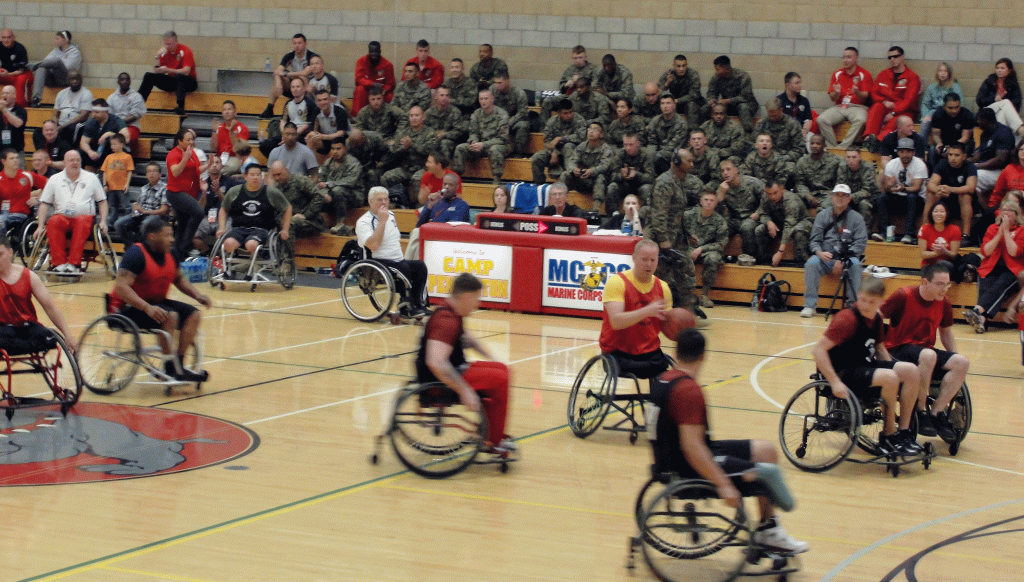
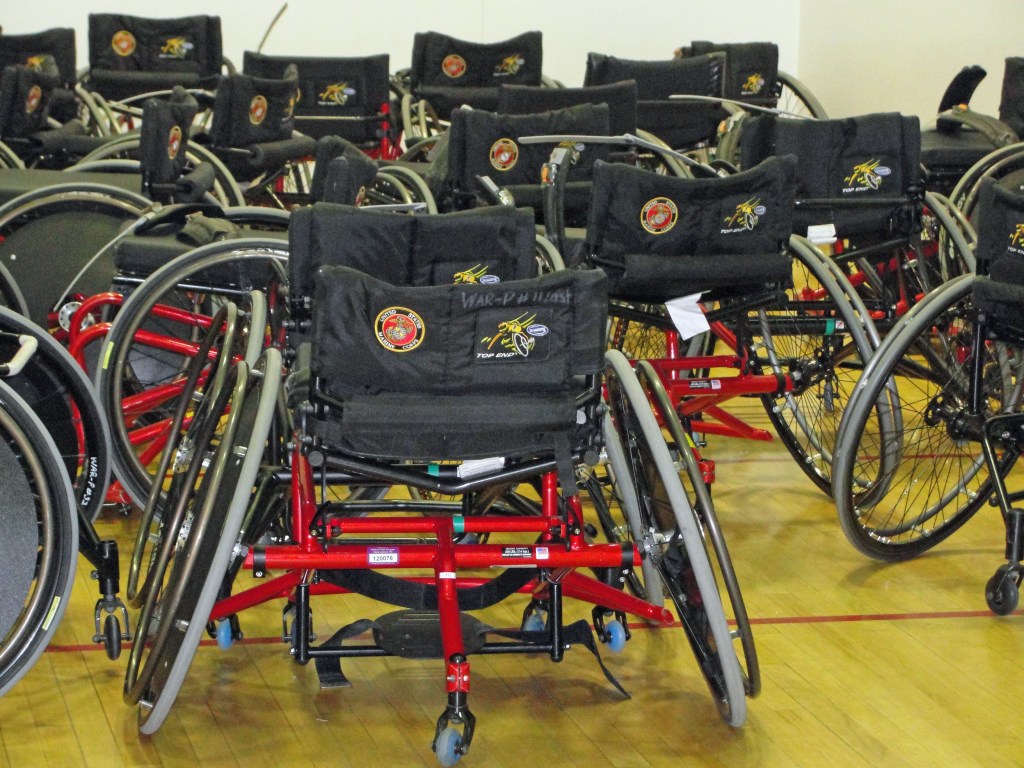
The Family Readiness officer spoke about her weekly conference call with spouses. The Future Initiatives and Public Affairs team described their current strategic lobbying and media activity. The Sargeant Merlin German Call Center, which resourced Wounded, Ill and Injured Active-Duty, Reserve and Veteran Marines and their family members across the country, reported the number of calls received over the weekend and a statistical breakdown of the presenting issues. The Warrior Athlete Reconditioning Program announced the date for the seated volleyball tournament at the Pentagon gym. My second favorite sport, I added it to my calendar. Oddly, it was the one athletic activity where still having one’s legs proved detrimental. But nothing could beat the thrill of Marines playing wheelchair basketball, with the added mix of wrestling, bumper cars and ballet.
A few more sit-reps were shared before SSGT Powerpoint announced, “Let’s end with some good news.” He advanced the slide. “Lance Corporal Smith is finally heading home.”
The CO said, “For those of you who don’t remember this high-vis case from a year ago, he and a fellow Marine were returning to Paris Island after a night out in Savannah, GA. The other Marine, the driver, didn’t notice the traffic circle ahead. He entered without braking, and the curb launched the vehicle into the air. It crashed at full speed into a tree. The passenger side, Smith’s side, took the brunt of it. Lance Corporal Smith has been hospitalized for a year. Have any of you met him?”
I raised my hand. “Sir, I’ve visited with him twice at the Richmond VA and briefly met his mom at the Naval Hospital in Portsmouth after his recent transfer.” I couldn’t imagine how they could send him home. The last time I saw him, he sat drooling in his wheelchair. His only means of communicating were the slight movement of one arm, a few grunts, and some eye blinking. Caring for Smith at home would be a full-time job.
The CO continued, “Lance Corporal Smith is now at the VA in New Haven, CT. At 1100 today, he will arrive at his family home. His Recovery Care Coordinator says a welcome home gathering of friends and family will be there to greet him. This is a great day. One of our men is going home.”
At the end of the meeting, I headed for my office to address items on my STD list. Since many of the tasks on this Stuff-To-Do list were recurring, annoying and usually socially transmitted, it seemed an apt name. Just after lunch, my assistant darkened my doorway.
“Chaps, they’re getting the band back together. Conference room. Fifteen minutes, Ma’am.”
Knowing this couldn’t be good, I grabbed my cup to retrieve more coffee. “Come with me. We’ll probably need it.”
He followed me to the coffee mess. I yawned.
I downed a few gulps of coffee and poured more. “Let’s get to the conference room to hear about the latest disaster.”
The CO arrived a few minutes later. “Seats, everyone. Here are the details. Lance Corporal Smith’s Recovery Care Coordinator (RCC) stopped by Smith’s home at 0930 to make sure everything was in order. No one was home, but the door was unlocked. He let himself in. What he found was an inappropriate environment for someone in Smith’s condition. Most rooms were under construction. There was no running water. And the bathroom attached to Smith’s room had no toilet. He sent me photos.”
We examined them on the screen.
“When Smith’s father got home, our RCC told him his son would not be coming home that day or ever unless the housing situation changed. A heated argument ensued and got worse when the dad found out the RCC had entered his home and taken pictures without his knowledge or presence. In front of the family and friends gathering at the curb, they screamed at each other. The dad grabbed a baseball bat and chased our RCC off his property. Just then, the Ambulette pulled up with the Lance Corporal inside. Our RCC spoke to the driver, and it pulled away.
The lead RCC asked, “Sir, did our guy call the police about the attempted assault?
“No. Thank goodness he was smart enough not to do that, or he could have been arrested for unlawful entry. He entered an empty house without permission.”
“But the dad went after him with a bat.”
“Yes, but the dad could argue he was chasing an intruder. The Marine Corps doesn’t want this mess in the news or for our RCC to be arrested. Thoughts?”
The mental health coordinator asked, “Has the dad contacted anyone since this happened?”
“Yes, he called the VA rep and demanded they bring his son home, but they can’t release the young man until the RCC signs off on the suitability of the residence. And we can’t send a different RCC because the dad has said that if anyone in a Marine uniform comes near his house again, he’ll beat them with his bat.”
I stared at the photos on the screen. Yes, they showed ongoing construction. So what? It wasn’t as if the young man could wander around the house and possibly hurt himself. And the water? Perhaps it had been turned off to install the toilet. Besides, Smith had a catheter and wore a diaper.
I asked, “Sir? He specifically said anyone wearing a Marine uniform?”
“Yes, Chaplain.”
“I have a Navy uniform.”
The room grew silent. Perhaps they were contemplating who would deliver my eulogy…
The CO spoke. “Make the arrangements, Chaps. You fly tomorrow morning.”
As soon as I landed in Hartford, CT, I rented a car and drove to the McDonald’s near the Smith’s home. I downed a cup of coffee, then changed into my Navy dress blue uniform. Looking in the mirror, I smiled and made the sign of the cross. As a Methodist, it’s not part of my tradition, but it seemed like a good idea under the circumstances.
Before stopping at the Smith’s house, I drove around the neighborhood. The modest homes showed age, a few looked run down, but mostly, the area seemed to house blue collar working families.
I stopped in front of the Smith’s home. The grass had recently been mowed. To the left of the driveway sat a rented dumpster, a sign of ongoing renovation. A raised ranch, the house was larger than most others on the street. I took a breath to collect myself. Okay, God, it’s just you and me. Please let me keep my head… and my cool. I walked to the front door and knocked. I heard muffled voices, then the door opened part-way. A tall, black man in work clothes looked out.
“Can I help you?”
“Mr. Smith? I’m Chaplain Laura Bender. I’m here about your son.”
He stared at me intently. I moved my hand to my purse strap so the cross on my sleeve would be visible.
“You’re a chaplain?” He paused and turned his head. Someone behind him spoke but I couldn’t hear the words. He turned back toward me. “Would you like to come in?”
“Yes, Mr. Smith, I’d love to.”
As I entered, I noticed his wife standing on the stairs. “Why don’t you bring her up here to the kitchen and I’ll make us some coffee?”
“I’d love some coffee, thank you. I don’t know if you remember me, but I met you in Portsmouth a few weeks ago when your son was there for an evaluation.”
“I thought you looked familiar.”
“I heard about the unfortunate incident that occurred yesterday, and I’m here to see if we can get things back on track. I’m sure you’re eager to get your son home.”
Mr. Smith and I sat at the table in the middle of the clean and neat kitchen. A small chandelier hung over the stairs I had just climbed.
“What a beautiful fixture,” I said, pointing. “I love the brass flowers interspersed among the lights.”
“I bought it at the Habitat for Humanity store when I was looking for bathroom cabinets. Do you know about that store?”
“Know it? My husband practically lives there. He brought home a light for over our stairs, too. It’s matte brass and looks like shafts of wheat.
Mrs. Smith put three cups of coffee on the table and sat. We chatted about all our good Habitat finds as we drank.
“So, are you doing a lot of renovations?”
“Yeah. See, when our son was in that accident, we were living in an apartment in Bridgeport. There was no way we could bring him home there. No room and we didn’t own the place, so we couldn’t make any modifications. When he got his TSGLI check, we used it to buy this house. I know it was his money, but we needed a proper home for him. The house was cheap because it needed a lot of work, but I figured over time I could get it done. I gutted the kitchen and redid it first. You gotta be able to cook.”
I nodded. “You did a real nice job. Cabinets from Habitat?”
“Mostly everything I’ve installed is. Some men from church helped me, too. But that Marine who came here yesterday let himself in through the garage. All he saw were the rooms I haven’t finished yet.”
I let Mr. Smith vent for a few minutes without interrupting. For the most part, I agreed with him. Although the RCC was required to check the house for suitability before authorizing their son to go home, he shouldn’t have entered without permission. I also wondered how much race and class had been factors in the white RCC’s decision. If a white father in a middle-class suburb was renovating some rooms, would he have acted the same?
“Would you like to see what I’m working on?” he asked. He took me on a tour of the house. We started in his son’s bedroom. A hospital bed sat in the middle of the room, aligned with the window so his son could see life outside.
“See this vertical beam that starts over his bed and extends into the bathroom?” He reached above his head and slid a device along the beam. “A harness attaches here and will help me lift my son. Then I can slide him over to the bathtub.”
“That’s genius.”
He beamed. “I figured I’d need assistance with his weight. I’m not getting any younger.”
I pointed to the now-in-place toilet. “Wax seal give you any trouble?”
“No. I hadn’t planned to do that until today, but since some guys from the church were here for the homecoming that didn’t happen, they gave me a hand. We did the toilet first. Dishes were piling up in the kitchen sink and their wives and mine were giving me the look…”
Proud of his handiwork and happy to show it off, Mr. Smith took me from room to room to see what he’d already done and explain his plans.
Two hours after I had approached the Smith’s front door with fear and trembling, I departed with hugs. My next stop was the VA hospital to see our Lance Corporal. On the way, I called the regimental head of the Recovery Care Coordinators to report on my visit. By the time I reached the VA, the decision had been made. LCPL Smith squeezed my hand when I told him the news, and a tear ran down his cheek. He was ready.
The next morning, as I flew back to DC, Lance Corporal Smith arrived at his new home where his father was now his full-time caregiver, so his mother could continue her work as a hairdresser. Around the country, other parents and spouses began their day by bathing and feeding their wounded, ill or injured warriors. Young men and women who had served their country well, sat on the edge of their bed to attach prosthetic limbs. Too many Marines woke alone in empty homes because their unaddressed PTSD and TBIs had chased away their families. Others wondered if today was the day to end their torment.
I headed back to the Wounded Warrior Regiment to join my colleagues in the continued fight to shield WII Marines from further harm, praying that our efforts would honor their level of commitment and their sacrifice.
Copyright © 2026 bendertales.com
9/11 Adulting Atrocity baptism Character Christmas Covid-19 Crazy CrazyParishioners Drama ElieWiesel faith Family ForgetMeNot GTMO GuardianAngel Haironfire Holidays Honor Indifference Iraq Joy Later life love MaundyThursday Memories Michigas Military Mothers Navy TalkToTeens Thinking Tightrope TrustGod USMC USS NEW YORK veteran Vulture Wappingers war WhatMatters wisdom WoundedWarriors writing
 Bender Tales
Grateful you are telling the stories of your service. Once a chaplain, ALWAYS! love,laura
LikeLike
To Shield and Protect
A comprehensive look at the workings of the Wounded Warrior organization. The responsibilities and duties of the chaplain here are many and varied. I believe working with the families may have been the most challenging and the most rewarding. One of the themes in this story is illustrated in the contrast between the inspection officer and the chaplain whereas the officer considers the letter if the law while the chaplain understands the spirit of the law. This contrast makes for great reading and a satisfying resolution.
Excellent writing Laura!
LikeLike