This is your fault. Well, maybe not yours in particular, but over the years enough people have told me I should write down whatever story I was telling them, I’ve decided to do it. Perhaps I am ill-advised. No matter. Bad advice often leads to interesting stories.
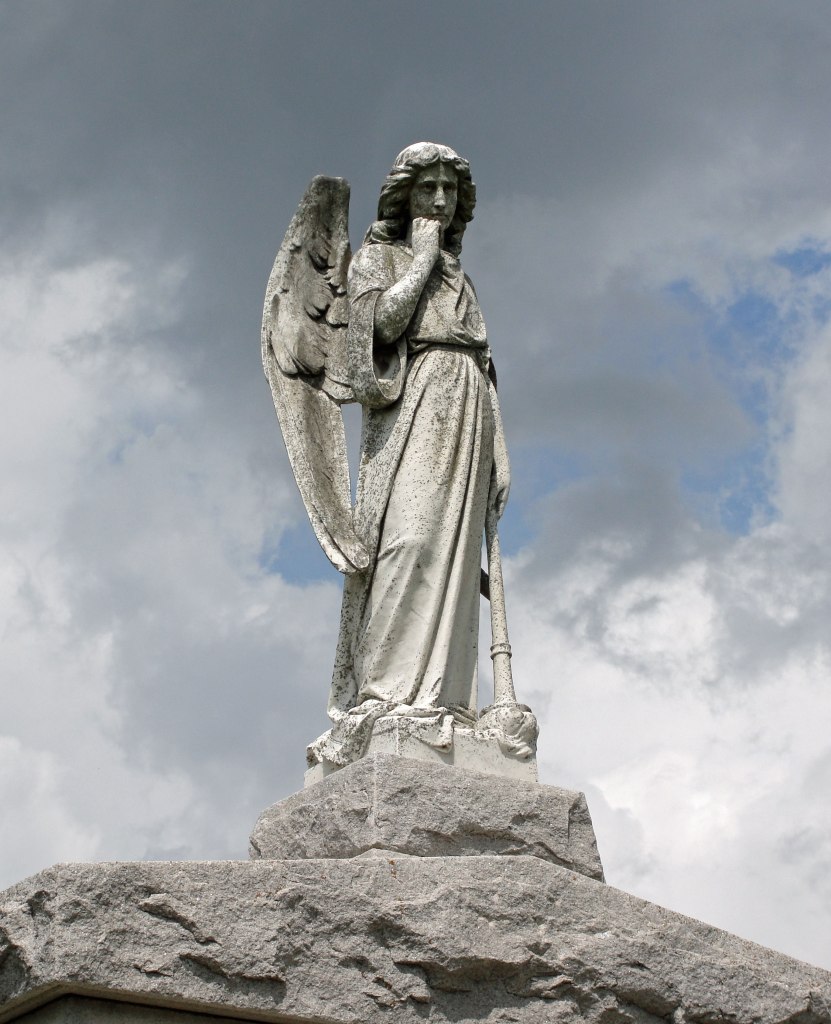
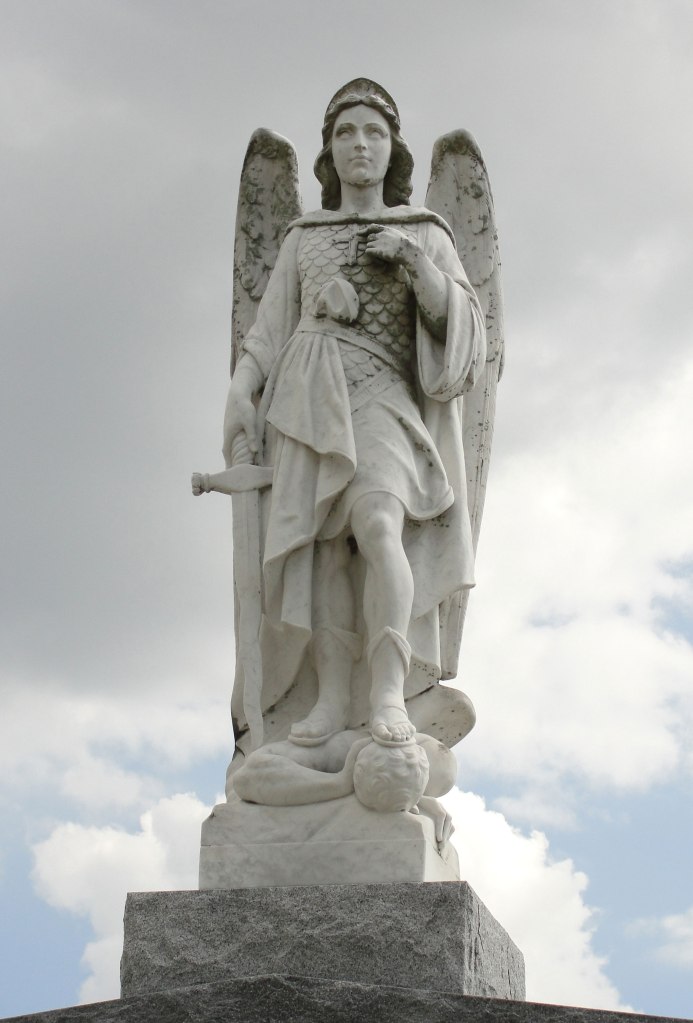
Metairie Cemetery looks like a miniature McMansionville. Every street is lined with houses for the dead, many far nicer than those often occupied by the living. Most are constructed of marble with carved accents and accompanying statuary.
A few have elaborate stained-glass windows, which I find puzzling, since stained- glass can only be appreciated from the inside with the light shining through and since the residents of these dwellings are currently dead, well… it seems a waste.
But on the day I visited, I had no room to talk about what made sense since I’d spent most of the sweltering hot afternoon wandering alone in search of a statue I’d seen only in a photograph. I had no clue where it was located, and to make matters worse, I believed it to be inside one of the mausoleums.
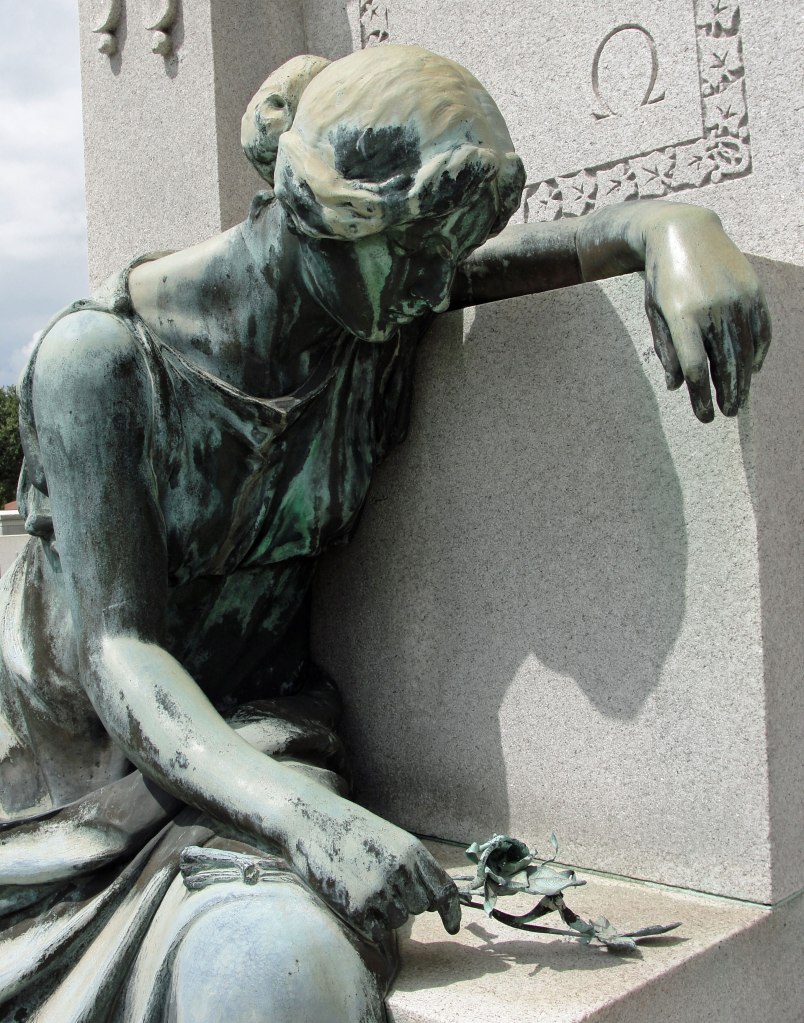
So, I wandered with camera in hand from one curious tomb to another, peering in any opening for a glimpse of the angel. My angel. I really wanted to see her with my own eyes, for I felt that if I had a guardian angel, it was she who had been that stone carver’s inspiration. Who else but my angel would have flung herself over top of an altar in exhaustion, her right arm bent under, cushioning her head and her left dangling in despair? Only my angel could look so worn out and frazzled, with her wings tucked around her like she might be trying to escape for a few minutes beneath them before she had to resume the no doubt frustrating task of watching over me. So I searched, for I believed that in that cemetery was a statue that defined my life in a way no other could.
I had just come around a corner on foot, camera at the ready when I saw it. Oh no, not the angel–I found her a little while later, tucked away in a tomb west of the front gate. And yes, when I eyed her, I half expected her to raise her marble head and say with an exasperated tone, “What? Can’t I have just a few minutes of peace?”
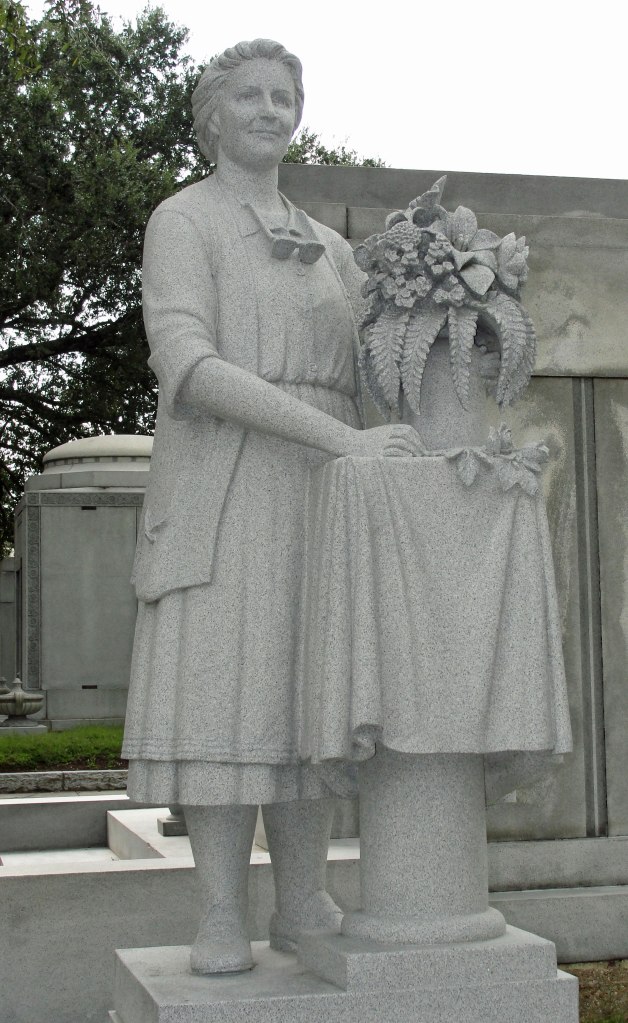
And why would she need them? Because in that cemetery I also found this carving, which I know is of me, even though I do not remember posing.
Back in the Dark Ages (when I was growing up) the word “adult” was a noun. It described a person who had transitioned from a dependent status, in which someone else was ultimately responsible for them, to that of an independent entity, responsible for themselves. An adult was something you became–no going back.
Lately I have been hearing the word adult being used as a verb, as in “I don’t want to adult today.” While I completely understand the need to relax one’s efforts periodically to maintain balance in life, the idea of choosing not “to adult” confuses me. If you drop the responsibility for yourself, who do you think will it take over for you? Likely it will be someone you resent for “telling you what to do,” such as a roommate, a supervisor or a spouse who equally resents having to tell you to do it, and then game on.
To keep from having to play that game, here is a quick list of questions to assess how adult you are:
Can I self-regulate my feelings and responses to others so I am fit company?
Can I maintain a reasonable attitude so I am not overcome?
Can I acknowledge how I feel instead of blaming others for making me feel ____.
Do I make wise relationship choices, avoiding toxic people and the drama that defines them, especially in my closest relationships–including parents and spouse?
Am I considerate and kind – not one who spreads hate and discontent?
Do I maintain a stable schedule for working, sleeping, nourishment, fitness and recreation conducive to health?
Do I manage my income and expenses so I may enjoy my life now while also planning appropriately for the future?
Do I keep my place and my stuff in reasonable order and repair so those who live with me do not have to resort to making passive aggressive posts on social media because I don’t respond to their nagging?
Do I seek medical intervention when necessary and then actually follow the doctor’s orders?
Do I maintain proper hygiene? Or are vultures eying my me and my dirty laundry because the smell makes them think I am dead?
Do I take responsibility for my choices, including those I make by default, those I thought were a good idea at the time and those that are just plain stupid?
Do I feel empowered and capable to lead myself?
Do I have realistic and measurable goals for the future? Am I willing to push through difficulties so that I may achieve them? (Being a Sad Panda living in a relative’s basement playing video games is not goal, it is a waste.)
When I make a commitment, is it my bond?
Have I maintained my integrity and upheld my personal moral code so that I am proud of my reflection in the mirror?
Do I really want to become an adult (no going back) or am I going to remain a self-centered, whiny child in a larger body?
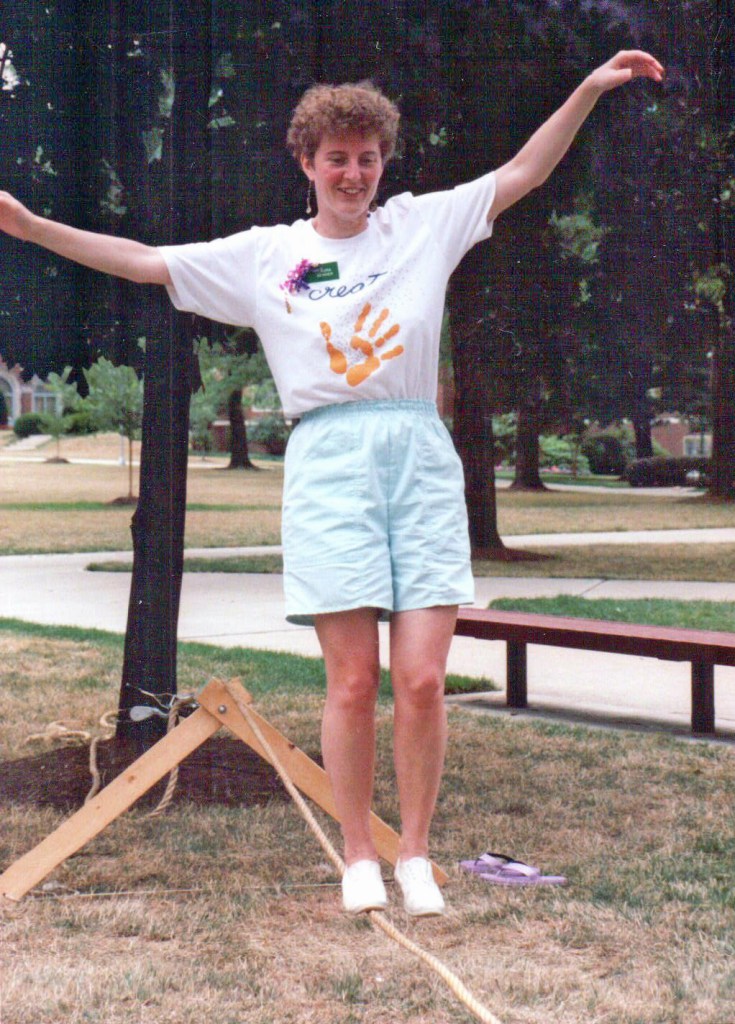
There is nothing more relaxing to a harried mind than time spent walking along a tightrope in the summer air.
The two large trees on the front lawn of my parsonage provided an excellent spot to set up the rig, and the parishioners proved more than happy to explain their eccentric pastor to the neighbors. Besides, many of them had tried walking the rope themselves, including Jane, who was about seventy, and wore her bathing suit for the occasion. Of course the youth group loved it and found lots of good reasons for me to set it up for them..
Although it might not seem so, rope walking is easy. Step up on the rope with one foot. Find your balance by focusing on an eye-level spot in front of you, feel for the rope with your other foot and then shift your weight. That’s it. To move forward, you must keep your eyes on your destination and not on your feet, since you always move in the direction of your gaze. You must also clear your mind of all other thoughts, lest you fall off in a heap from the distraction, which makes this an excellent meditative practice for increasing focus and reducing stress.
I learned rope walking at a Phoenix Performing Arts Conference and after a year of practice became the instructor. Each summer at the end of our week-long gathering we would take our act out in public and entertain the locals. One year when I set up the rope in the public venue, a young girl asked if she could walk it like the other kids were doing. The aide pushing her wheelchair whispered, “She cannot walk at all.”
“Get in line and wait your turn,” I told the girl. The puzzled aide wheeled her to the back of the queue, likely hoping what I was planning would not embarrass her young charge. When the girl made it to the front of the line, I hopped up on the rope and walked a bit to attract an audience. Then I jumped down and my assistant and I helped the girl out of her chair. We lifted her on to the rope, just like we had done for every other child, and taking her outstretched arms, guided her down the length of the rope. The experience wasn’t much different with her than it had been with every other unbalanced child we had carried. When the walk was complete, and she received her applause, we returned her to the wheelchair. As I bent over to place her in her seat, she looked at me and smiling said, “I’m going to tell everyone I do all my best walking on tight ropes!”
The night had been too short, and now the flight attendant was coming around with a good morning wake up: hot coffee, a muffin, a mint and a wash-up in a foil wrapper. Sleepily, I broke a few pieces off the muffin and forced myself to eat them. Breakfast, at what was for me one AM, was hard to swallow. I washed it down with the coffee and opened the package containing the towelette. It felt good to wash my face and hands, and to clear the not-enough sleep from my eyes.
As I freshened up, I thought of the foil packaged towelette I had removed from my purse only a few hours earlier. That one had been in there so long the foil had cracked and the moist towel inside had dried and hardened. But I was “saving it.” I’m not sure why. Things I save in my purse almost never get used. Like the foil-covered chocolate with pen holes in the wrapper and sand (from the shells I was saving) sticking to the exposed candy. Or the sugar, which a long time ago had broken out of its package and lay on the bottom, covering my loose change, and getting under my fingernails whenever I reached for a quarter. Or the stick of gum, so hard that it could be shattered with a hammer. These and several other delights had been finally tossed out in the “I’m going on vacation” cleaning of my purse. I thought of them as I enjoyed the moist cloth freshening my face and hands.
Why hadn’t I used that other towelette, or chewed the gum? Why hadn’t I put that sugar in my tea, or enjoyed the fancy foil-wrapped chocolate? For what had I been saving them? To throw away when they eventually became unusable? And what else in my life had I been saving on the top shelf somewhere? A fancy dress? A sketch pad? The good china? Vacation brochures? Hopes? Dreams?
Suddenly things became so clear. Life, and all the good things in it, were meant to be lived, used, enjoyed and savored, not hidden away for later. For sometimes, later never comes, or when it does, it’s too late. The gum has hardened, the towelette has dried out, and we’ve missed it.
Just then, the voice of the pilot interrupted my thoughts to say we were landing in Shannon. The flight attendant made a hurried pass down the aisle, collecting the refuse from breakfast. I wadded up the cellophane from the muffin with the remains of the used towelette, put them inside my empty coffee cup, and handed the trash to the attendant. Then I checked my seat belt, placed my chair back and tray table into their upright positions, and tossed the mint into my purse for later.
To my grandchildren, on the day you each turn fifteen and a half:
It might seem funny to be receiving a letter from me at your half-birthday, but by now Grandpa has probably clued you in that it is best just to humor me if what I do seems unusual… That’s what he does… And I love him, anyway.
Although this letter might seem funny, it is actually quite serious. I’d like to talk with you about something I think you are old enough to learn about, even if your parents may not agree. In fact, they probably would not like me to tell you what I am about to, because, in their eyes, you are still children needing to be sheltered from the harshness of the world.
(And as I write this, I pray, that in the years it took for you to turn 15½ the world has not taught you this lesson already.)
The reason I want you to read this at your half-birthday is that half-birthdays are better days for thinking deep thoughts about what it means to be human and alive and part of the world, whereas actual birthdays are better for celebrating those things.
And fifteen? Why this age? Because I want to introduce you to someone who was fifteen when he learned this lesson. His name is Elie Wiesel. He was born in Transylvania (no he is not a vampire…) Transylvania is the name of a region in Romania, but for a few years, when he was a boy, the borders of the country shifted and his hometown of Sighet became part of Hungary. Sometimes during war, borders can shift like that. Other things can shift, too, like the rules people live by, or the things they value, but we’ll get to that later. Let me tell you more about Elie.
He was born on September 30, 1928, which means that he is five years older than your Great Grandma. His parents, Shlomo and Sarah, owned a grocery store. He had two older sisters, Hilda and Bea, and a younger sister, Tsiporah. They lived in a house on a corner in town. They were Orthodox Jews, and at the age of three, Elie began to study at the Jewish school. As he grew, he spent much of his time in study and in prayer.
By the time Elie was a teenager, World War II was already being fought in Europe. News of the war reached his home town, but few paid much attention. About this time, Elie made friends with a man named Moche who was a caretaker at his synagogue. Both were interested in the subjects Elie was studying, and they often had long conversations together about these things.
One day, soldiers entered Sighet and rounded up all the foreign-born Jews, put them on a train and took them away. Elie’s friend Moche was among them. Why did the soldiers do that? The caretaker at the synagogue was probably not much of a threat to national security. Neither were any of the other people loaded on to the trains. They were taken away just because they were Jews.
Now imagine if a bus drove through your town and stopped at the home of every foreign-born Christian family and forced them to drop what they were doing and get on the bus immediately. What would you do? How would you feel? How would you cope? And when they never returned, would you seek after them or just let it go?
When it happened to Moche and the others, people in the town chalked it up to the war and felt sad, but did nothing. Rumors eventually passed that those who had been deported had resettled in another country, and life went on. Then one day, months later, Moche returned.
Many years later, Elie wrote about Moche in a book called Night. You will probably read it for History or English, and when you do, you will find it terribly disturbing. You will find it so for the same reason that your parents would not be happy with me sending you this letter–they want to protect you. Well, I want to protect you, too, but not from imaginary monsters under the bed that threaten to harm your childhood. I want to protect you from that which will harm your humanity. Already, I am sure, you have experienced people capable of cruelty or abuse. You are old enough to know that ugly things can happen in families, at school, between neighbors, even at random. You’ve watched the news and spoken intimately with your friends. You know. But what I am about to tell you goes beyond that level of cruelty.
When Moche returned to Sighet, he returned with a story. And he went from house to house telling that story as if his life depended on the telling. He was passionate. His message was urgent. But nobody wanted to listen. Why? Because what he had to tell them was unthinkable. Moche told them that soon after the trains filled with the foreign-born Jews had left Sighet, they stopped in a remote area. Everyone disembarked, and the Jews were marched into the woods. There they were made to dig a big hole and when it was finished, every one of them was shot and thrown into the hole. Then the babies were thrown into the air like clay pigeons and shot before they landed. Moche was the only one to escape because he did not die of his wound.
If you had heard Moche tell this story, what would have been your reaction? Anger? Fear? Disbelief? Passion – moving you to action? Thankfulness – that it wasn’t you who was killed? Indifference? What would have been your response? I want you to think about that, because all through your life you will be hearing of atrocities and injustices, of “man’s inhumanity toward man,” and just the hearing of it will demand of you a response.
But let’s go back to Elie’s story a little more:
When the people in Elie’s hometown heard Moche tell of his horrific experience, they tried to silence him, as if by not listening to what he had to say, the truth would go away or change. I am reminded of a pet rabbit I had when I was a child. When he was afraid, he would bury his head under his paw as if by not looking at what he feared, he himself became invisible to the threat. As silly as that sounds, watch people. We all do the same thing. And that’s what the people in Elie’s town did–they pretended nothing was wrong. Then one day the soldiers came back, rounded up the rest of the Jews and put them in an area of the town which was then enclosed in barbed wire. Not long after, these Jews, too, were forced into train cars and taken away. Elie and his family were among them.
When Elie left on that train, he was your age. Fifteen. He had parents and siblings, he went to school, he studied, he laughed, he had friends. He was like you. Then one day his mother and little sister were shoved into an oven and burned to death. He watched a child hang by the neck until the child was dead. He saw, with his own eyes, a truckload of babies thrown into a fire. And only a few months after he arrived at the concentration camp to which he had been delivered by train, he watched his own father die a slow and painful death from dysentery, leaving him to face the agony of each horror-filled day alone.
Why would I, your grandmother, tell you about such things? Because if it could happen to Elie, it could happen to you.
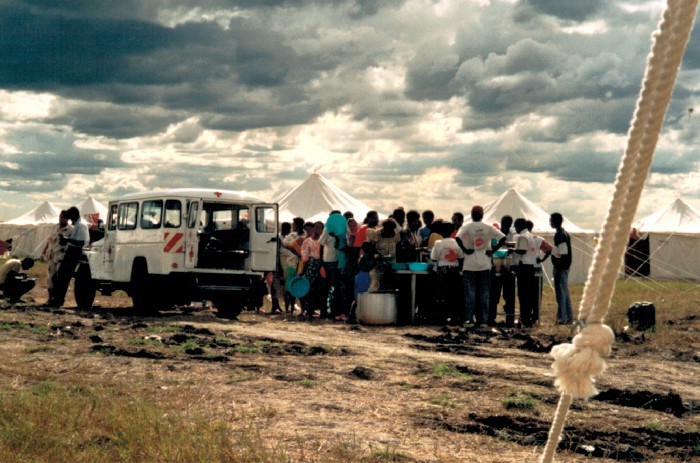
I am not trying to scare you. I just want to make sure you are awake. Most people go through their lives like my pet rabbit, with one paw over their eye, hoping that danger will never come near them. They don’t get involved in anyone else’s troubles, they never take a stand against evil, and they pretend that it couldn’t happen to them. But it can. I’ve seen it with my own eyes. I visited with Rwandan refugees in 1994, young people whose entire families had been massacred just a few days before. When I asked them how they had been able to escape, they said, “We ran the fastest…” Can you imagine running to save your life while your family is being hacked to death?
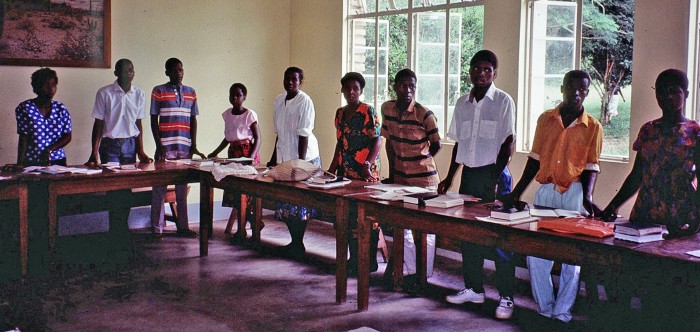
In Mozambique I visited a school where the entire previous High School class had been massacred by rebels who had broken into the building while they were studying. The walls were full of bullet holes and the windows were shattered. Yet, there in that classroom sat a new group of students determined that they would get an education, so they could lead their country into the future and away from such atrocity. These young people were your age. And I, your old Grandma, saw them myself. Yes, these things can happen.
But there is one more thing you must know. In Rwanda and Mozambique, and sad to say, in most places where these sorts of atrocities occur, often the perpetrators are your age, as well. “Recruiters” for this work make fine use of the idealism and inexperience of young people and therefore actively seek people like you to join them. So be aware. To those who would do harm, you are a valuable commodity. Make sure you do all in your power to remain a person, instead of a tool.
So, what happened to Elie? Several months after his father died, Elie’s camp was liberated by American troops. Now you might think having gone through such an ordeal would have destroyed any hope Elie might have had for the future. But that was not so. It is more accurate to say that his hopes and priorities and desires were rearranged, as they so often are for people who have experienced the harshness of war. At first, he was overcome by silence. He could not find words to describe the inhumanity he had experienced and the loss of his father, mother and younger sister, his home and all the people who had been his world in Sighet. But gradually, he found his voice. As Elie’s teaching assistant Ariel explained to me, half in jest, “When a Jew wants to start a rebellion, he writes a book.” That’s just what Elie did. Remember that book Night I talked about earlier? In that book, Elie chronicled his experience in the concentration camp in such a way that it gained international attention. Other books were to follow- more than thirty of them, as well as plays and articles. As he became more well known, he was able to use his fame to become a spokesperson for human rights in places like the former Soviet Union, Rwanda, South Africa, Bosnia, Kosovo and Dafur and to create a permanent Holocaust Memorial in the United States. Grandpa and I have been there. I hope we get to take you to see it, because it is a powerful way to learn a difficult but necessary lesson about what happened to all the grandpas, mothers, sisters, cousins and friends, who died during the Holocaust only because they were Jewish.
In 1986, Elie was awarded the Nobel Peace Prize for his tireless work on behalf of human rights. He also received many other awards and honors, including the Presidential Medal of Freedom, the United States Congressional Gold Medal, and the Grand Croix of the French Legion of Honor. In 1988 he established the Elie Wiesel Foundation for Humanity, and in 2006, the British recognized him with an honorary knighthood. Despite all these honors, Elie remained a humble and gracious man, devoted to his family, prayer and study. But his greatest devotion was to “memory” which he served faithfully through the telling and retelling of his story and thereby the story of the six million Jews whose lives had been extinguished in the Holocaust. Elie did this, not just to preserve the remembrance of those who had died, but in their name, to do all in his power to see that it never happened again.
When Moche and the other foreign-born Jews were taken away, the other Jews did not speak up. When the rest of the Jews were deported, the Christians closed their doors and let the “Christ killers” as they thought of them, be dragged off to their deaths. When nations, such as the United States, learned of the camps, we did nothing to stop the death trains. Why? Why were and are people silent in the face of unimaginable atrocity?
Fear is a great silencer. Often, we are silent, not because we don’t care or we don’t know right from wrong. We are silent because we foolishly believe that somehow our silence will save us; it will exempt us from the awful fate of others. What we don’t realize is that although our silence may protect us from the momentary evil around us, it gnaws away at our souls until one day, although we remain alive, as human beings we are dead. As the gospel tells us, “What good is it for a man to gain the whole world, yet forfeit his soul?” That’s what I want to protect you from, dear grandchildren – from losing the very essence of what it means to be human.
Fear is a silencer. But far worse than fear is indifference. Fear, at least, is a reason. Indifference is no reason. Indifference means that there is no relationship between you and me. What happens to you affects me not at all, and I may not even notice. Indifference is what allows us to watch the news each night and while hearing about murders, genocide, natural disasters and other people’s agony, quietly eat our dinner and think about what our next entertainment will be. In his book entitled Legends of Our Time, Elie spoke about the effects of indifference upon those who suffer. He said, “At the risk of offending, it must be emphasized that the victims suffered more, and more profoundly, from the indifference of the onlookers than from the brutality of the executioner. The cruelty of the enemy would have been incapable of breaking the prisoner; it was the silence of those he believed to be his friends–cruelty, more cowardly, more subtle–which broke his heart.”
Elie, the boy who at fifteen endured the horrors of the concentration camp, devoted his life to a courageous, sustained protest against indifference. As he told me, “The young man I was then, is in me still, and he does not let me away with easy answers.” In reviewing one of Elie’s books, the reviewer made this comment which seems to sum up that devotion, “While Elie Wiesel lives and writes, there will be no rest for the wicked, the uncaring or anyone else.”
And that, dear grandchildren, is the reason I am writing to you about him. In 2007, I had the privilege of being his student, of hearing his wisdom, of being able to ask him questions and hear his answers. On the last day of class, one of my classmates asked him why, at age 79, he was still teaching at Boston University, still getting up at 5 AM to spend several hours of each day writing and why he was still traveling around the world to advocate against indifference and for peace in places like Dafur. His answer was that he continued to do these things out of a sense of urgency. Knowing that he did not have many more years before his voice would be silenced by death, he could not relax his efforts. In fact, by the time you read this, he will have been gone from us for several years, having closed his eyes for the last time on a bright July morning in 2016. Since he is no longer here to hold us accountable in the face of evil and indifference, the task falls to those who remain. And so I am passing his message to you. And perhaps long after I am gone, you will pass this message on to your grandchildren, and they to theirs, for it is a message for every generation.
So often, the adjective used to describe atrocity is “unimaginable.” What I am asking you to do is to imagine. But not with a mind that sees death and killing as part of a video game with a reset button-no, I want you to see it for all its horror and awfulness and be outraged. I want you to know that it can happen, that it does happen, that modern lifestyle and technology and globalization does not prevent it, and perhaps has made it more likely, though with more sophisticated means.
And what breeds atrocity? Indifference, which comes from a lack of relationship. If we do not see our futures connected, if we do not see that what happens to one of us affects all of us, anything, any awful thing, is possible. How does this happen? First, we stop trying to understand one another. Then we stop feeling for one another. And soon, the other becomes a non-person, a thing, a commodity. And then, any awful thing becomes possible. Please, do not let that happen… again.
With love, Grandma Laura
PS. Here’s a picture of Grandpa and me visiting with Elie – Professor Wiesel – at his office in December 2007.
“Is that smoke?” I wondered, as I read email in a room down the hall from my kitchen. I paused for a moment and sniffed the air. Curious, I stuck my head into the hallway. The living room looked foggy. Just then I remembered–dinner! I hurried to the kitchen, reaching there just in time to see the oil I had earlier placed in the frying pan catch fire. Seeing the flame I panicked and instead of reaching for the pan lid to smother the burning oil, I grabbed the handle, moved the pan to the sink and turned on the water. Immediately, flaming mist began floating out of the sink and the hair on the front of my head caught fire. As it rained down my face in a fine powder, I placed my hand on my head, cutting off the oxygen and putting out the fire. It was then that I realized the phone was ringing. I guess I hadn’t noticed it over the sound of the smoke alarm. “Are you having an emergency?” the calm voice of the security company employee asked when I picked up the receiver. “No, I am fine, thank you,” I replied before hanging up. I didn’t want to get into a philosophical conversation with her about how not thinking, though often the cause of emergency situations is not in and of itself an emergency. Besides, if I had told her I was, at that moment, a victim of Mishigas, she would have sent the authorities to find the culprit. This would have been even more embarrassing than having to go to work the next day with my bangs seared off at an awkward angle, for Mishigas is not a perpetrator, but a Yiddish word which loosely translated means “self-created chaos and craziness.” Now who wants to admit they have caused their own drama?
You know how it goes:
You didn’t think about gathering up gear for work the next day because there was a football game on TV. You also didn’t remember to set the alarm before you fell asleep on the couch. Now you are angry at the slow drivers preventing you from getting to work on time where soon you will learn that you left your office key on your dresser at home.
You didn’t think word of your most recent exploits would reach the ears of your significant other, but now you are calling around to see which one of your buddies will let you sleep on his couch.
You know the holidays are coming, but you didn’t think they would arrive this soon. Now you are over committed, under prepared and thoroughly exhausted.
Mishigas – self created chaos – it’s what follows statements like:
“I’m pretty sure I have enough gas to get home.”
“I don’t need to read the directions; I know what I’m doing.”
“It’s been in the refrigerator a long time, but it’s probably OK to eat.”
“I’m only going to do this once. I’m sure I’ll get away with it.”
“A wedding should be pretty easy to plan.”
“Hey ya’ll, hold my beer and watch this!”
The chaos that follows remarks like these can be everything from hilarious to tragic, yet most of the time the drama could be avoided by doing one simple thing – thinking.
When we look to the Biblical text, we see that not even our spiritual ancestors were immune from Mishigas:
Eve didn’t think taking the advice of a serpent over God’s command would lead to difficulty (Genesis 2 -3). David didn’t think calling for Uriah’s wife, Bathsheba, to join him on the roof would have tragic results (2 Samuel 11). Samson didn’t think revealing the secret of his great strength to Delilah, an ally of his enemy, the Philistines, would lead to his demise (Judges 16). Read their stories. It is amazing how like us they are. Perhaps God is trying to tell us something…
Since the holiday season is now upon us, I’d like to suggest that this year we give ourselves and those we love a special gift. Less Mishigas. In this season of peace let us:
Pay attention. Ask for directions. Use the right tool. Drink less. Fill up the gas tank. Make an executable plan and pray for discernment – especially around extended family…
Me? I’m going to back away from the stove and enjoy my husband’s cooking!




























 Bender Tales